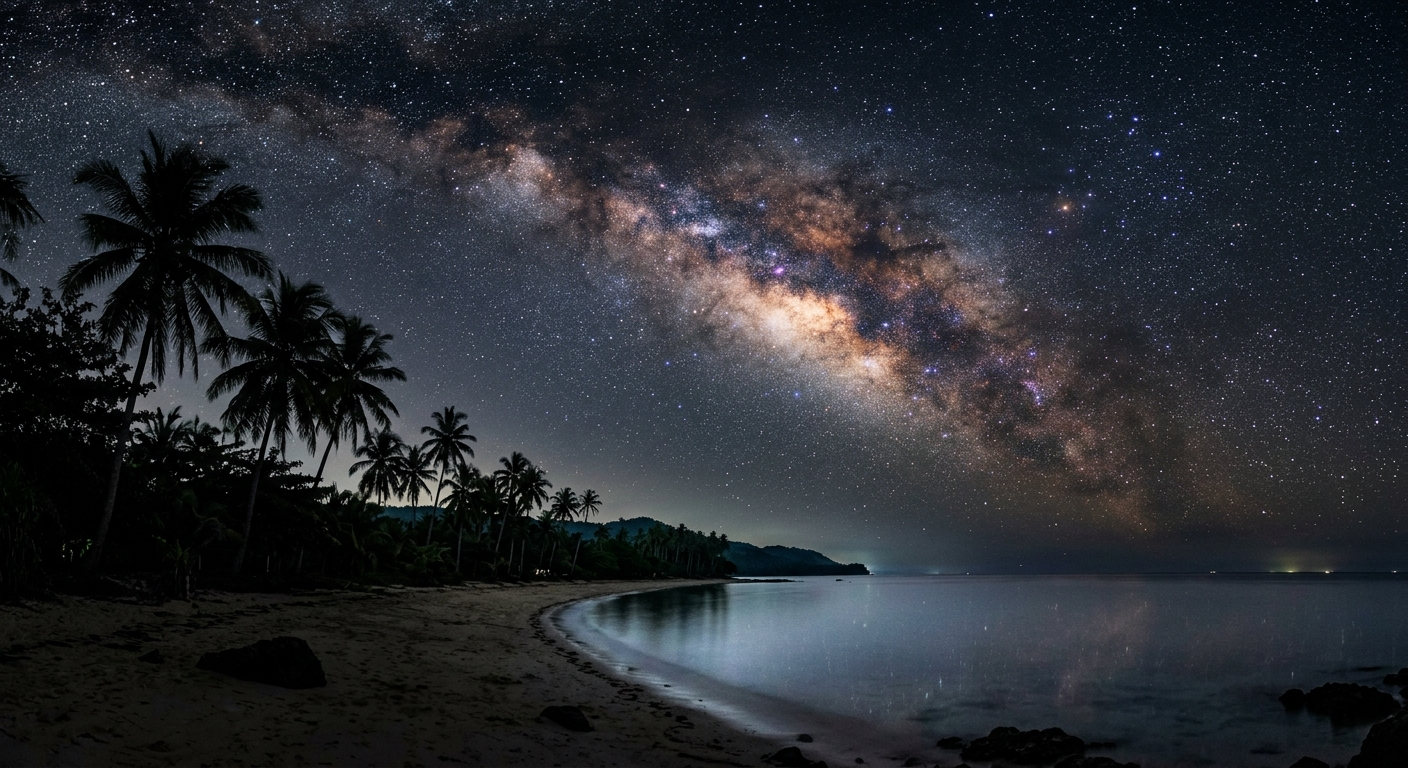
Siquijor Stargazing Guide: Best Dark Sky Spots on the Mystic Island
Find the best stargazing spots on Siquijor Island. Dark sky locations, Milky Way viewing tips, and astrophotography guide for this low light-pollution Philippine island.
 Island Adventures Team
 Why Siquijor Is One of the Best Stargazing Destinations in the Philippines
Most travelers come to Siquijor for waterfalls, beaches, and healing traditions. Few realize that the island offers something equally extraordinary after the sun goes down: an almost pristine night sky. With a population of roughly 100,000, minimal industrial development, and large stretches of unlit coastline, Siquijor ranks among the darkest islands in the central Visayas region.
Light pollution is the enemy of stargazing, and Siquijor has remarkably little of it. The six municipalities — Siquijor town, Larena, Enrique Villanueva, Maria, Lazi, and San Juan — are small and spread out. Once you move a few hundred meters away from the main road, the sky opens up in ways that most urban Filipinos have never experienced.
On a clear, moonless night between March and May, the Milky Way stretches across the sky in a luminous band visible to the naked eye. Star clusters, planets, and even the faint glow of the Andromeda Galaxy become accessible without any optical equipment.
Best Time for Stargazing in Siquijor
The dry season, which runs from approximately late January through May, offers the clearest skies. March and April are particularly ideal because humidity levels are lower than in the transition months, and the air is less hazy compared to the burning season that sometimes affects other parts of the Visayas.
Moon phase matters. The best stargazing happens during the new moon phase, when the sky is at its darkest. In late March 2026, the new moon falls on March 29, making the final week of the month exceptional for observation. Even a quarter moon can wash out fainter objects, so plan accordingly.
Optimal hours. The core of the Milky Way rises above the eastern horizon around 1:00 AM in late March and is best positioned between 2:00 AM and 4:30 AM. If you are targeting specific constellations or planets, check a star chart app like Stellarium or Sky Map before heading out.
Weather patterns. Even during dry season, brief cloud cover can roll in from the Bohol Sea. The interior highlands tend to have slightly more cloud activity than the coast. Check weather forecasts in the afternoon and be prepared to wait out passing clouds. Clear spells often return within 30 to 60 minutes.
Top Stargazing Locations Across the Island
Paliton Beach (San Juan)
Paliton Beach faces west-southwest, making it primarily a sunset destination, but it transforms after dark. The beach sits below a low bluff with no structures behind it producing significant light. The coconut palms that line the shore create dramatic foreground silhouettes for astrophotography.
Best for: Wide-angle Milky Way shots, casual stargazing on sand, couples looking for a romantic night experience.
Access: Turn off the main circumferential road at the Paliton signage in San Juan. A short dirt path leads to the beach. Bring a flashlight for the walk in.
Light pollution level: Very low. The nearest barangay lighting is several hundred meters away and partially blocked by vegetation.
Kagusuan Beach (Maria)
This small, crescent-shaped beach on the southern coast is one of the most isolated accessible beaches on the island. Known primarily as a sunrise spot, Kagusuan’s lack of development makes it exceptional for stargazing in all directions.
Best for: Serious observers and astrophotographers who want the darkest possible horizon. The southern sky, which contains some of the richest star fields visible from Siquijor’s latitude, is completely unobstructed over the open sea.
Access: From the main road in Maria municipality, follow the signs toward Kagusuan Beach. The final approach involves a steep path down to the sand. Do not attempt this in the dark unless you have scouted the trail during daylight.
Light pollution level: Minimal. Maria is the least developed municipality on the island, and Kagusuan sits well away from any village center.
Mount Bandilaan National Park
At 557 meters above sea level, Mount Bandilaan is the highest point on Siquijor. The summit area includes a viewing platform and open clearings that provide a 360-degree panoramic view. Being above the coastal haze layer makes a significant difference in sky transparency.
Best for: Observers who want to see the most stars possible. The elevation reduces atmospheric distortion and lifts you above low-lying moisture. The summit is also an excellent location for spotting meteors during annual showers, as you can see more of the sky dome from a single vantage point.
Access: A paved road leads most of the way to the summit. The final stretch may require a short hike depending on road conditions. Night access is straightforward by motorcycle, but bring warm clothing — temperatures at the summit can drop below 22 degrees Celsius during the early morning hours, which feels genuinely cold after acclimating to sea-level tropical heat.
Light pollution level: The lowest on the island. Looking inland from the summit, the few town lights below appear as faint clusters. Looking outward over the sea, there is virtually no artificial light.
Salagdoong Beach Area (Maria)
The coastal section around Salagdoong Beach, particularly the elevated areas near the cliff jumping platforms, offers excellent eastern and southern sky views. The beach itself is managed and gated, but the surrounding coastal areas are accessible.
Best for: Combining a daytime beach visit with early evening stargazing before the area closes. The elevated rock platforms provide stable, flat surfaces for setting up tripods.
Access: Follow the signs to Salagdoong Beach from the main road. The managed section has operating hours, but the surrounding coast remains accessible.
Light pollution level: Low to moderate. There is some facility lighting at the main beach area, but it diminishes rapidly along the coast.
Lazi Coastline (South of Town)
The stretch of coast south of Lazi town center, past the old church and convent, opens up into a quiet residential area with minimal lighting. Several rocky shoreline points offer stable, dry surfaces above the tide line.
Best for: Observers staying in or near Lazi who want a quick, accessible dark sky location without driving across the island. The southeastern sky is well-exposed, offering views of Scorpius, Sagittarius, and the galactic center during the pre-dawn hours.
Access: Walk or ride south from the Lazi town center along the coastal road. Look for rocky beach access points between barangay clusters.
Light pollution level: Low. Lazi town produces some sky glow to the north, but it is minor and does not significantly affect observation in other directions.
Enrique Villanueva Coastal Stretch
The municipality of Enrique Villanueva occupies the northeastern portion of the island and has some of the longest stretches of undeveloped coastline. The beaches here are less visited by tourists, which means fewer lights and fewer people.
Best for: Observers who value solitude and uninterrupted darkness. The northeastern sky is the least affected by any of Siquijor’s town lights.
Access: The main road passes through the municipality. Several unpaved turnoffs lead to the coast. Scout during the day to find a suitable spot.
Light pollution level: Very low. This is one of the least touristed parts of the island.
What You Can See from Siquijor
Siquijor sits at approximately 9 degrees north latitude, which provides access to a generous portion of both the northern and southern celestial hemispheres. Here is what to look for during late March and April:
The Milky Way. The galactic core rises in the southeast during the pre-dawn hours. From Siquijor’s latitude, the core passes nearly overhead, providing an exceptional viewing angle that observers in northern latitudes never experience.
Southern Cross (Crux). Visible from Siquijor but never from anywhere in mainland Europe or most of North America. Look for it low in the southern sky during the late evening and early morning hours. It serves as a useful orientation tool and is a rewarding target for visitors from higher latitudes.
Planets. Jupiter and Saturn are prominent in the pre-dawn sky during this period. Venus may appear as a brilliant evening star depending on its orbital position.
Meteor showers. The Lyrids peak around April 22, offering 10 to 20 meteors per hour under ideal conditions. Siquijor’s dark skies make even modest showers worth watching.
Satellites. The International Space Station and Starlink trains are frequently visible passing overhead. Apps like ISS Detector can predict exact pass times for your location.
Deep sky objects. With binoculars or a small telescope, targets like the Omega Centauri globular cluster, the Eta Carinae Nebula, and the Jewel Box cluster are accessible from Siquijor’s southern latitude advantage.
Equipment and Preparation
For Casual Stargazing
You need nothing except your eyes, a dark location, and patience. Allow at least 20 minutes for your eyes to fully dark-adapt after leaving any lit area. Avoid looking at your phone screen during this period — if you must check something, use a red-filtered flashlight or set your phone to its lowest brightness with a red screen filter app.
A simple reclining beach chair or mat makes a significant difference in comfort. Lying flat eliminates neck strain and lets you take in more of the sky dome.
For Astrophotography
A camera with manual exposure control, a sturdy tripod, and a wide-angle lens with a fast aperture (f/2.8 or wider) are the essential tools. Settings for Milky Way photography from Siquijor typically start around ISO 3200, f/2.8, and 15 to 20 second exposures, depending on focal length.
Bring extra batteries — long exposures in humid tropical conditions drain batteries faster than you might expect. A lens cloth is essential, as sea-adjacent humidity causes rapid lens fogging, especially in the hours after midnight when temperatures drop.
For foreground interest, Siquijor offers outstanding natural elements: palm trees, rocky shorelines, traditional fishing boats, and the silhouettes of old coral stone structures.
General Preparation
Mosquito protection. Coastal areas are less affected than the interior, but insect repellent is advisable for any extended outdoor session at night.
Footwear. Rocky beaches and uneven terrain require closed-toe shoes or sturdy sandals, especially in the dark.
Water and snacks. A stargazing session can easily last two to three hours. Stay hydrated and bring something to eat.
Navigation. Download offline maps and mark your chosen location during daylight hours. Cell signal can be weak in remote coastal areas.
Tide awareness. If you are setting up on a beach or rocky shore, check tide tables. Siquijor has a semi-diurnal tidal pattern, and water levels can change significantly over a few hours.
Combining Stargazing with Other Night Experiences
Siquijor offers several other night activities that pair well with stargazing:
Firefly watching. The mangrove areas near Larena and parts of the interior host firefly colonies. Visit the fireflies early in the evening, then continue to a dark sky location for stargazing.
Night swimming. Several beaches are safe for night swimming. The combination of warm water and a star-filled sky overhead is one of those experiences that visitors describe as unforgettable.
Full moon rituals. While the full moon itself washes out faint stars, the cultural experience of Siquijor’s full moon traditions is worth one night away from deep-sky observation.
Practical Tips for Night Travelers
Riding a motorcycle at night on Siquijor requires extra caution. The main circumferential road is generally well-maintained, but watch for potholes, dogs, and unlit vehicles. Use your headlight on high beam when there is no oncoming traffic, and wear light-colored clothing if walking along the road.
Most accommodation providers do not have late-night reception. If you plan to return after midnight, arrange access in advance or carry your room key.
Noise considerations matter in quiet barangays. Keep conversations low and avoid playing music near residential areas during late-night stargazing sessions.
A Final Thought on Siquijor’s Night Sky
There is a particular quality to standing on a dark beach in Siquijor, looking up at a sky thick with stars, while hearing nothing but waves and insects. The island has been called mystical for centuries, and while that reputation usually refers to its healing traditions and folklore, there is something genuinely transcendent about its night sky.
As light pollution spreads across Southeast Asia and the Philippines continues its rapid development, places like Siquijor where you can still see the Milky Way with your naked eyes are becoming rare and valuable. Whether you are a serious astrophotographer or someone who simply wants to remember what the sky is supposed to look like, Siquijor delivers.
Plan a moonless night into your itinerary. Set an alarm for 2:00 AM. Walk to the nearest dark beach. Look up. It is worth every lost hour of sleep.
Island Adventures Team
Night sky enthusiasts documenting Siquijor's celestial wonders.
Related Experiences

Budget Travel Siquijor: Complete Money-Saving Guide
How to experience Siquijor on a budget - cheap accommodations, free attractions, money-saving tips, and sample budgets for backpackers.
Romantic Siquijor: A Couples & Honeymoon Guide
Plan the perfect romantic getaway in Siquijor. Secluded beaches, sunset dinners, couples activities, and the best accommodation for an intimate island escape.

Digital Nomad Guide to Siquijor: Remote Work in Paradise
Everything remote workers need to know about working from Siquijor: internet, coworking, accommodation, costs, and whether this island suits nomad life.