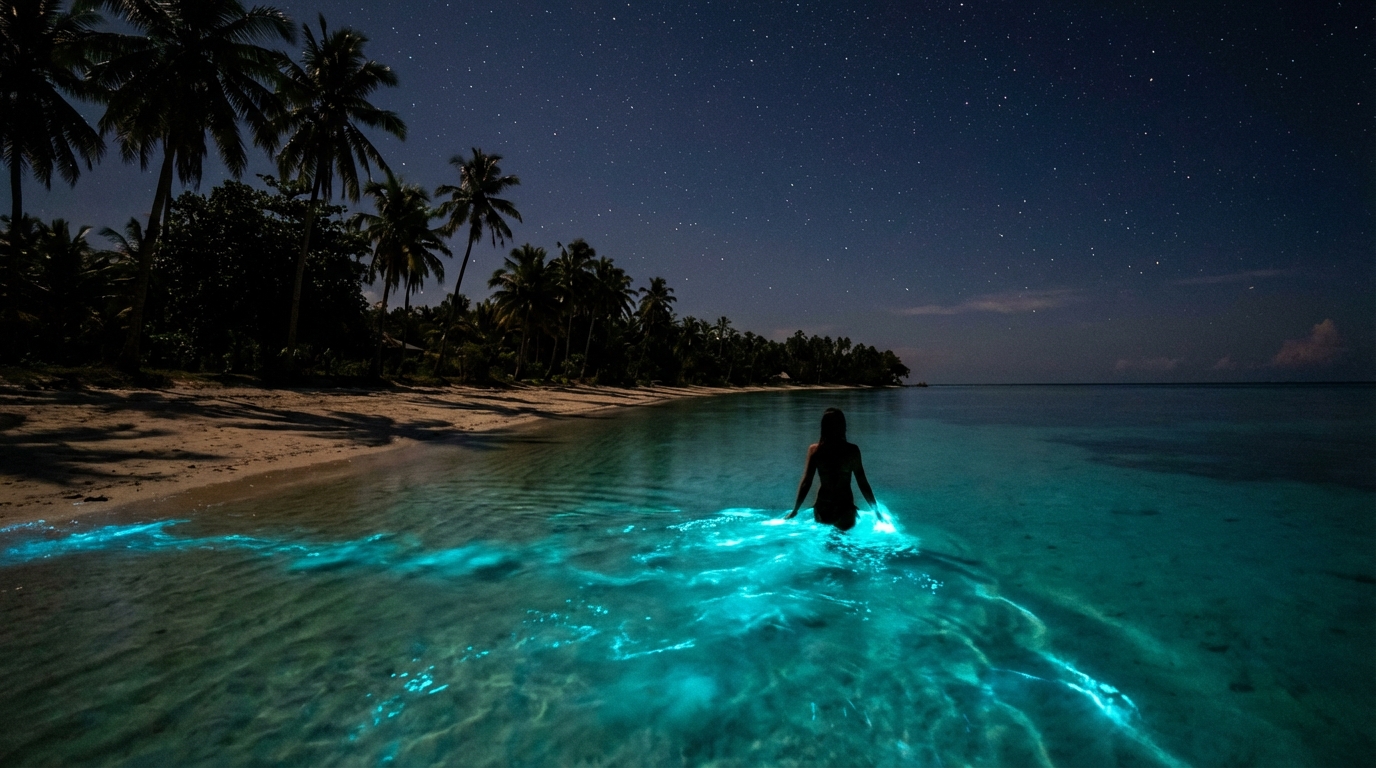
Siquijor Bioluminescence Night Photography: Complete Guide
Learn to photograph Siquijor's bioluminescent plankton with expert camera settings, timing tips, and the best coastal locations for capturing glowing blue-green light shows.
When darkness falls over Siquijor and the last ferries pull away from the dock, a different kind of magic begins. Along the island’s sheltered bays, mangrove channels, and calm swimming holes, microscopic organisms called dinoflagellates begin to glow. With every disturbance — a hand dipping into the water, a kick of a swimmer’s fins, the lap of gentle waves against the shore — these single-celled plankton flash brilliant blue-green light. The effect is otherworldly, and Siquijor has become one of the Philippines’ most rewarding destinations for photographers who want to capture it.
This guide covers everything you need to know: where to find bioluminescence in Siquijor, when conditions are best, what camera gear you need, and the specific techniques that separate a good photograph from a stunning one.
Understanding Siquijor’s Bioluminescence
Bioluminescence occurs when dinoflagellates — most commonly Pyrocystis lunula and various Noctiluca species — are mechanically disturbed. The organism triggers a chemical reaction involving luciferin and luciferase that produces light without heat. In Siquijor’s warm, nutrient-rich waters, these blooms occur naturally, particularly during the warmer months from March through October, though they can appear year-round under the right conditions.
What makes Siquijor special is the combination of sheltered coastlines, limited light pollution in rural areas, and a growing awareness among local boat operators and guides about where and when the phenomenon appears. Unlike some destinations where bioluminescence has been commercially packaged, Siquijor’s glowing waters remain a somewhat spontaneous natural event.
Best Locations for Bioluminescence Photography
San Juan’s Sheltered Bays
The municipality of San Juan, along Siquijor’s eastern coast, offers some of the most consistent bioluminescence sightings. The gently sloping sandy bottom and reduced boat traffic create ideal conditions. Small coves between the main road and the beach are particularly good — any area where water collects in a shallow basin overnight tends to concentrate the organisms.
Mangrove Channels Near Lazi and Maria
Siquijor’s mangrove systems, particularly those accessible from Lazi and Maria municipalities, provide protected channels where bioluminescence is frequently observed. The dark, tannin-stained water creates natural contrast that makes the glow more visible, and paddling a kayak or paddleboard through these channels at night produces trails of luminous blue wake.
Cambugahay Falls Pools
While the main waterfall attracts most visitors during the day, the natural pools downstream from Cambugahay Falls occasionally display bioluminescence during warm, calm nights. The advantage here is the freshwater element, which can produce a different visual character than marine bioluminescence.
Tubod Marine Sanctuary
The Tubod Marine Sanctuary near Siquijor town has documented bioluminescence events, particularly around the new moon period when darkness is deepest. The sanctuary’s protected status means water quality remains high, supporting the plankton populations that create the glow.
When to Go: Timing for Maximum Impact
Moon Phase
The moon is the single most important factor in bioluminescence photography. The darker the sky, the more dramatic the bioluminescence appears both to the naked eye and in photographs. Plan your shoot around the new moon — in April 2026, the new moon falls on April 23. The days immediately before and after the new moon offer progressively darker skies.
Full moon nights make bioluminescence nearly impossible to photograph, as ambient light overwhelms the dinoflagellate glow. Even a bright crescent moon will reduce the apparent intensity.
Weather Conditions
Calm, warm nights produce the best bioluminescence. Wind stirs the surface water and can disperse plankton concentrations. After a few days of settled weather, particularly in the warmer months, dinoflagellate concentrations tend to build in sheltered areas.
Heavy rainfall can dilute seawater and wash organisms away. Avoid the night immediately following a significant rain event. However, light rain on already-warm nights can actually trigger blooming behavior.
Time of Night
Bioluminescence is typically strongest after 10 PM, when boat traffic has ceased and the island has quieted. The glow often peaks around midnight to 2 AM. Give your eyes at least 20 minutes to adapt to the darkness — once your night vision develops, you will see the glow far more clearly than initially.
Camera Gear: What You Actually Need
You do not need professional underwater housing to photograph bioluminescence. The glow is best captured from above the surface, with the water functioning as a reflective medium rather than requiring underwater photography techniques.
Recommended Gear
A mirrorless or DSLR camera with good high-ISO performance is ideal. Full-frame sensors handle the extreme ISO values required better than crop sensors, though modern APS-C and Micro Four Thirds cameras produce excellent results. Sony A7 series, Fujifilm X-T series, and Canon R series cameras all perform well in this scenario.
A sturdy tripod is essential. You will be making long exposures of 10 to 30 seconds, and hand-holding is not an option.
A wide-angle lens in the 14mm to 24mm range allows you to capture both the glowing water and the surrounding landscape — a silhouette of palm trees against a starry sky, for example.
Alternative: Smartphone Photography
Modern smartphones with Night Mode can capture bioluminescence, though the results will be significantly inferior to a dedicated camera. Place the phone on a stable surface or use a small smartphone tripod. Enable the longest exposure setting available. The images will be soft and noisy, but they will convey the experience.
Camera Settings for Bioluminescence Photography
ISO
Start at ISO 1600 to 3200 for initial test shots. If your camera handles high ISO well, push to ISO 6400 or higher. Remember that long exposure noise reduction can be applied in post-processing, but too-low ISO simply means an underexposed image.
Aperture
Use your lens’s sweet spot — typically two to three stops below wide open. For most kit lenses, this means f/4 to f/5.6. Wider apertures like f/2.8 allow shorter exposures but increase the risk of shallow depth of field in landscape elements.
Shutter Speed
Exposure times of 10 to 30 seconds are typical. The longer the exposure, the more the bioluminescence accumulates in the frame, creating a smooth, glowing surface. Shorter exposures of 5 to 10 seconds capture more texture and individual sparkles.
White Balance
Set white balance manually to around 4000K to 5000K for a natural blue-green color. Auto white balance tends to overcorrect, producing colors that look artificial. Shoot in RAW format to have full flexibility in post-processing.
Composition Techniques
Silhouette Work
Place a subject — a swimmer, a kayak, a palm tree — between your camera and the glowing water. Expose for the bioluminescence alone, and the subject becomes a dramatic silhouette. This is the most reliable technique for producing striking images.
Reflection Shots
With perfectly still water, the bioluminescence creates a mirror-like reflection. Position your camera low to the water surface to maximize the reflection area. A wide-angle lens pointing slightly downward works well.
Movement Trails
Capture kayak paddles, swimming arms, or dropping stones into the water to create glowing trails and ripples. This requires practice and multiple attempts. Use a remote shutter release to avoid camera shake.
Environmental Context
Include the night sky, shoreline vegetation, or traditional fishing boats to give the bioluminescence geographic and cultural context. A lone banca (traditional boat) silhouetted against glowing water tells a more complete story than water alone.
Working with Local Guides
Siquijor’s local guides are increasingly aware of bioluminescence photography requests. Arrange an evening boat tour through your accommodation or directly with operators in San Juan and Lazi. Explain that you are a photographer looking for calm, dark conditions. Most operators will understand and can position you in the best spots.
Expect to pay a modest guide fee. Always ask about the moon phase before booking — an experienced guide will know whether recent conditions have been favorable.
Post-Processing Basics
Process RAW files to enhance the natural blue-green color without over-saturating. Subtle adjustments to clarity and dehaze can make the glow appear more luminous. Reduce noise using your software’s luminance noise reduction, but avoid aggressive noise reduction that removes the fine texture in the water surface.
For smartphone images, apps like Lightroom Mobile allow basic adjustments to exposure, white balance, and noise reduction that can significantly improve results.
Conservation Considerations
Bioluminescence depends on healthy plankton populations in clean water. Avoid using sunscreen immediately before entering bioluminescence areas — many chemical UV filters are toxic to marine organisms. Rinse off before entering the water if you have applied sunscreen.
Do not use flash photography directly on the water surface, as intense light can damage plankton. Ambient light long exposures are the responsible approach.
Planning Your April 2026 Shoot
April offers excellent conditions for bioluminescence photography. The summer season means warm water temperatures, calm evenings, and minimal rainfall. With Easter week behind us, the island returns to its quieter rhythm, making it easier to arrange private guide services and find dark, secluded coves.
Consider combining a bioluminescence shoot with one of Siquijor’s established night activities — firefly watching in the mangrove areas near San Juan, for example, covers both glowing phenomena in a single evening excursion.
Pack light, arrive early, and give your eyes time to adapt. The glowing water will reward patience and preparation with images that feel more like dreams than photographs.
Siquijor.xyz Editorial Team
Local experts sharing authentic Siquijor experiences
Related Experiences

Budget Travel Siquijor: Complete Money-Saving Guide
How to experience Siquijor on a budget - cheap accommodations, free attractions, money-saving tips, and sample budgets for backpackers.
Romantic Siquijor: A Couples & Honeymoon Guide
Plan the perfect romantic getaway in Siquijor. Secluded beaches, sunset dinners, couples activities, and the best accommodation for an intimate island escape.
Digital Nomad Guide to Siquijor: Remote Work in Paradise
Everything remote workers need to know about working from Siquijor: internet, coworking, accommodation, costs, and whether this island suits nomad life.