Siquijor Traditional Music and Dance: The Island's Living Performing Arts
Discover Siquijor's vibrant musical heritage from kuratsa folk dance to rondalla string ensembles. Where to experience traditional performances, festivals, and the cultural roots of island music.
On any given evening in Siquijor, if you happen to pass through a barangay during a fiesta, a wedding, or even a simple community gathering, there is a strong chance you will hear music that has nothing to do with the pop songs blasting from karaoke machines or the electronic beats from beachside bars. Instead, you might catch the clear tones of a guitar trio playing in harmony, the rhythmic clapping that accompanies a couple performing the kuratsa, or the collective singing of a balak that tells the story of the island’s past.
Siquijor’s musical traditions run deep. As one of the smallest provinces in the Philippines, it might seem unlikely that this island would maintain a rich performing arts culture. Yet isolation has been preservation’s greatest ally. The same geographic distance that kept Siquijor off the mainstream tourism radar for decades also helped protect cultural practices that have faded on more developed islands throughout the Visayas.
The Kuratsa: Siquijor’s Signature Folk Dance
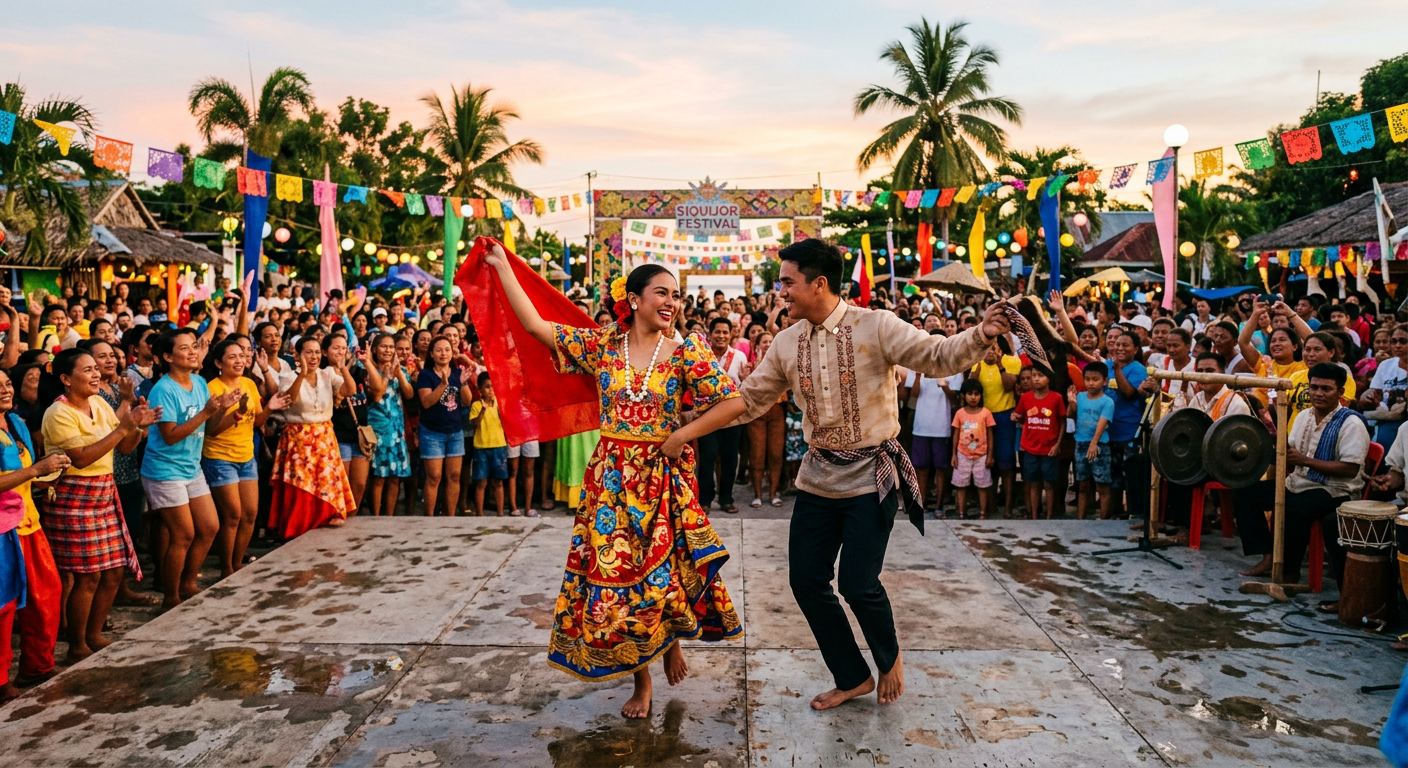
No discussion of Siquijor’s performing arts can begin without the kuratsa, the courtship dance that remains the single most recognized cultural expression on the island. While the kuratsa is performed across the Eastern Visayas and parts of the central Philippines, each region has developed its own variation, and Siquijor’s version carries distinct characteristics that reflect the island’s personality.
The kuratsa is fundamentally a dance of pursuit. A man and a woman face each other, and through a series of graceful steps, hand movements, and turns, they enact a wordless conversation of attraction, hesitation, playfulness, and eventual acceptance. The woman moves with measured elegance, her fan or handkerchief held with deliberate poise, while the man circles and approaches with controlled energy, neither too aggressive nor too timid.
What makes the Siquijor kuratsa distinctive is its pace. Compared to the Leyte or Samar versions, which tend toward exuberance and speed, Siquijor’s interpretation often runs slower, with more emphasis on the subtlety of gesture. The dancers’ feet stay closer to the ground. The turns are wider. There is a certain gravity to the performance that mirrors the island’s overall temperament: unhurried, deliberate, and deeply felt.
Where It Lives Today
The kuratsa has not been relegated to museum demonstrations or tourist shows. It remains a living social practice. At weddings in Siquijor, particularly in the municipalities of Lazi and Maria, couples are frequently invited to dance the kuratsa as part of the celebration. Guests pin money onto the dancers’ clothing, a tradition called “money dance” that supports the newlyweds while keeping the cultural practice alive.
During fiestas, particularly the feast days of patron saints in each municipality, the kuratsa appears as both formal performance and spontaneous expression. Professional cultural dance groups may open the evening with choreographed versions, but as the night progresses and the tuba flows, older community members often take the floor and demonstrate the steps they learned from their own parents and grandparents.
The Dilaab Festival, Siquijor’s province-wide celebration held each September, regularly features kuratsa competitions that draw participants from all six municipalities. These competitions have become an important mechanism for transmission, as younger dancers train for months under the guidance of elders to prepare their entries.
Rondalla: The String Ensemble Tradition
If the kuratsa represents the physical expression of Siquijor’s performing arts, the rondalla represents its musical soul. The rondalla is a string ensemble tradition brought to the Philippines during the Spanish colonial period, adapted and transformed over centuries into something distinctly Filipino.
A traditional Siquijor rondalla typically consists of a bandurria (a small, pear-shaped stringed instrument that carries the melody), an octavina (which plays harmony), a laud (providing countermelody), a guitar (for rhythm and bass harmony), and a bajo de unas (a large bass instrument). Some ensembles add a piccolo bandurria for higher melodic lines.
What distinguishes Siquijor’s rondalla tradition from those of Luzon or Mindanao is the repertoire. While rondalla groups elsewhere have largely shifted toward performing popular songs and classical arrangements, Siquijor ensembles have maintained a strong connection to local compositions. Many of the pieces performed at community gatherings are original works by island musicians, some dating back generations, passed down through oral tradition and handwritten notation.
The Sound of Community
In Siquijor, the rondalla is not a performance for passive audiences. It is community music. During fiestas, baptisms, and town celebrations, rondalla groups provide the soundtrack for social gatherings, playing through the evening while families eat, talk, and dance. The music creates an atmosphere rather than demanding attention, weaving itself into the fabric of the event.
Several barangays in Lazi and Siquijor town maintain active rondalla groups. The instruments are often handmade by local craftsmen, with the bandurria and octavina constructed from jackfruit or mahogany wood sourced from the island’s interior. The process of building these instruments is itself a craft tradition, one that connects instrument-making to the broader ecosystem of Siquijor’s artisanal heritage.
Schools in the province have played a significant role in keeping the rondalla alive. The Department of Education’s regional programs include rondalla training as part of cultural education, and several Siquijor schools participate in provincial and regional competitions. For many young Siquijodnons, learning to play the bandurria or guitar in a school rondalla represents their first engagement with the island’s musical heritage.
Balak and Siday: The Oral Poetry Traditions
Beyond dance and instrumental music, Siquijor maintains rich traditions of sung and spoken poetry. The balak is a form of sung verse common throughout the Visayas, and in Siquijor it serves as both entertainment and historical record. Balak compositions cover themes ranging from love and courtship to local history, moral lessons, and commentary on community events.
The performance style of balak in Siquijor typically involves a solo singer accompanied by a guitar, though some versions are performed a cappella. The melodies tend to be simple and repetitive, serving as vehicles for the words rather than showcasing vocal technique. A skilled balak performer can improvise verses on the spot, responding to the mood of the audience or incorporating current events into traditional melodic frameworks.
The siday is a related but distinct form: a spoken or chanted verse often delivered at formal occasions such as weddings, funerals, and community meetings. The siday in Siquijor functions as both blessing and narrative, with practitioners using elaborate metaphorical language drawn from the natural world. A siday at a wedding might compare the couple to a coconut palm and the sea, each needing the other to thrive.
Preservation Through Practice
Unlike some Philippine oral traditions that now exist primarily in academic archives, Siquijor’s balak and siday remain in active use. Elders in rural barangays continue to compose and perform, and community events still feature these art forms alongside more modern entertainment. However, the number of practitioners who can improvise complex siday compositions has declined as younger generations show less interest in mastering the demanding art form.
Several cultural organizations in the province have initiated documentation projects, recording performances by elder practitioners and creating written transcripts of traditional compositions. These efforts represent a recognition that while the traditions are still alive, they are vulnerable to the same forces of modernization and media saturation that have eroded oral traditions throughout the archipelago.
Liturgical Music and Church Choirs
Siquijor’s deep Catholic heritage has produced a parallel musical tradition rooted in the church. The island’s historic churches, particularly San Isidro Labrador in Lazi and St. Francis of Assisi in Siquijor town, have maintained choir traditions that blend European sacred music with Visayan linguistic and melodic sensibilities.
Church choirs in Siquijor perform in Cebuano, the island’s primary language, translating Latin and English hymns into the vernacular while also performing original compositions by local church musicians. The result is a body of sacred music that sounds distinctly different from what you might hear in a Manila cathedral or a Luzon parish.
During Holy Week and the Christmas season, these choral traditions reach their fullest expression. The Pasyon, a sung narrative of Christ’s suffering performed during Lenten observances, can last for hours and involves multiple singers taking turns. In Siquijor, the Pasyon is performed in a melodic style specific to the Visayan region, with long, sustained phrases and ornamental flourishes that give the singing an almost hypnotic quality.
The Flores de Mayo, celebrated throughout May, brings another musical dimension. Young women and children process through towns singing hymns to the Virgin Mary, accompanied by rondalla music and decorated with flowers. In Siquijor’s smaller barangays, these processions retain an intimate, community-centered character that has been largely lost in more urbanized parts of the Philippines.
Contemporary Adaptations
Siquijor’s musical landscape is not frozen in the past. A growing number of island musicians are finding ways to blend traditional elements with contemporary styles, creating music that resonates with younger audiences while maintaining connections to heritage.
Local bands performing at bars and restaurants in San Juan and Siquijor town occasionally incorporate rondalla instruments or kuratsa rhythms into their sets, creating fusion arrangements that surprise audiences expecting standard cover-band fare. Some musicians have begun recording original compositions that draw on balak melodic structures while using modern instrumentation and production techniques.
The tourism industry has also created new contexts for traditional performance. Several resorts and tour operators now include cultural shows featuring kuratsa demonstrations and rondalla performances as part of their offerings. While there is always a tension between authentic cultural expression and commercial entertainment, these venues provide economic incentives for performers and exposure for art forms that might otherwise remain invisible to visitors.
Social media has emerged as an unexpected preservation tool. Young Siquijodnons have begun sharing videos of festival performances, family celebrations featuring the kuratsa, and rondalla rehearsals on platforms like Facebook and TikTok. These videos reach the island’s significant diaspora community, connecting overseas Siquijodnons with the cultural practices of their homeland and generating renewed interest in traditional arts.
Where Visitors Can Experience Traditional Music and Dance
For travelers interested in experiencing Siquijor’s performing arts firsthand, timing and location matter.
Fiestas offer the most authentic and accessible opportunities. Each of Siquijor’s six municipalities celebrates its patron saint’s feast day at a different time of year. The Lazi fiesta in May, the Maria fiesta in September, and the Siquijor town fiesta in November are particularly known for strong cultural programming that includes kuratsa competitions, rondalla performances, and community singing.
The Dilaab Festival in September is the provincial showcase, featuring cultural competitions, street dancing, and performances from groups across the island. This is the single best event for seeing the full range of Siquijor’s performing arts in one concentrated period.
Church services at the historic parishes, particularly Sunday masses at Lazi Church, regularly feature choral music that reflects the island’s sacred musical traditions. Visitors are welcome to attend and listen.
Community events such as weddings, baptisms, and birthday celebrations occasionally welcome curious visitors, particularly in smaller barangays where the culture of hospitality extends naturally to strangers. Asking your accommodation host about upcoming community events can lead to spontaneous cultural experiences that no tour operator can arrange.
Cultural centers and schools sometimes host performances or rehearsals that are open to the public. The provincial government has discussed plans for a dedicated cultural center that would provide a permanent venue for traditional performing arts, though as of 2026, most performances still take place in community halls, churches, and open-air spaces.
The Future of Siquijor’s Performing Arts
The performing arts of Siquijor face the same pressures that challenge traditional cultures throughout the developing world. Younger generations are drawn to global music and entertainment. Migration to cities and overseas reduces the pool of potential practitioners. The economic realities of island life make it difficult for performers to dedicate time to arts that generate little direct income.
Yet there are reasons for cautious optimism. The island’s growing tourism industry creates audiences and economic opportunities for traditional performers. Provincial government programs support cultural education and festival programming. The tight-knit nature of Siquijor’s communities means that cultural practices are transmitted not through institutions alone but through family and neighborhood networks that remain strong.
Perhaps most importantly, the performing arts of Siquijor are not museum pieces. The kuratsa is danced at weddings. The rondalla plays at fiestas. The balak is sung at gatherings. These art forms remain woven into the social fabric of island life, practiced not as conscious acts of preservation but as natural expressions of community identity.
For visitors, encountering these traditions offers something that no waterfall or beach can provide: a window into the interior life of a community, the values it holds, the stories it tells, and the ways it celebrates being alive on a small, beautiful island in the middle of the sea.
Siquijor.xyz Editorial Team
Related Experiences

Siquijor Artisan Workshops: Weaving, Woodcarving & Local Crafts
Discover Siquijor's traditional crafts through hands-on workshops. Learn from local artisans who preserve ancestral techniques in weaving, carving, and more.
Fishing with Siquijor's Fishermen: A Pre-Dawn Ocean Adventure
Join local fishermen for an authentic pre-dawn fishing experience. Learn traditional techniques, witness sunrise at sea, and connect with Siquijor's maritime culture.
Siquijor Food Guide: Local Dishes & Where to Eat
Discover Siquijor's authentic cuisine from street food to seafood feasts. Local restaurants, traditional dishes, and the flavors that define the island.