Siquijor Street Food Guide: Night Markets, Local Snacks and Where to Find Them
Discover the best street food in Siquijor Island, from night market favorites to roadside grills. A complete guide to local snacks, prices, and the top spots to eat like a local after dark.
There is a side of Siquijor that most travel guides overlook entirely. While visitors spend their days chasing waterfalls and lounging on white-sand beaches, the island transforms after sundown into a quietly thriving street food scene that rivals anything found in the bigger Philippine cities. The difference here is scale and intimacy. In Siquijor, the person grilling your skewers might be the same fisherman who caught your squid that morning.
Street food on this island is not a tourist attraction engineered for Instagram. It is ordinary life made visible. Families gather around smoky roadside grills, tricycle drivers pull over for a quick snack between fares, and children run between stalls clutching plastic bags of sticky rice cakes. For the visitor willing to step away from the resort restaurant menu, this is where Siquijor reveals its truest flavors.
The Night Market Scene
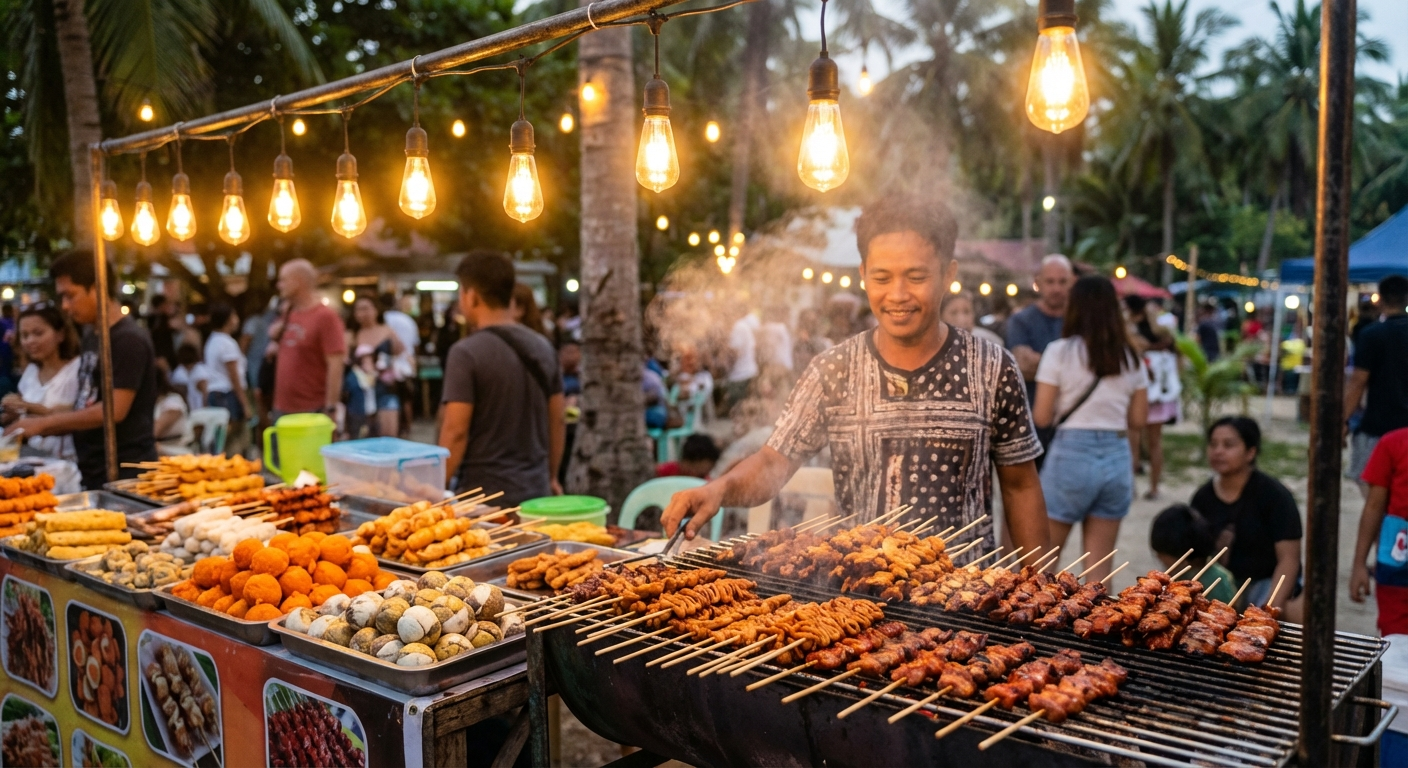
Siquijor’s night market culture has grown steadily over the past few years, driven partly by tourism and partly by the simple economics of island life. When the heat of the day breaks, vendors set up folding tables and charcoal grills along main roads, transforming quiet stretches of highway into open-air food halls.
San Juan Night Market
The most established night market scene centers around San Juan, the municipality that serves as the island’s unofficial tourism capital. Along the main road near the public market, vendors begin setting up around 5 PM. By 6 PM, the stretch is alive with smoke, sizzling oil, and the warm glow of hanging bulbs.
What you will find here changes with the season and the catch, but regulars include grilled pork belly (liempo), chicken intestines on sticks (isaw), fish balls swimming in sweet or spicy sauce, and enormous skewers of squid brushed with a soy-calamansi glaze. Prices hover between 10 and 50 pesos per item, making this one of the most affordable dining experiences on the island.
The San Juan night market is not a permanent fixture with fixed stalls. It is more fluid than that. Vendors rotate, new ones appear, and the best way to navigate it is simply to follow your nose. If a stall has a crowd of locals around it, that is your signal.
Siquijor Town Evening Stalls
The capital town of Siquijor (locally called Poblacion) has its own quieter version of the night market scene, concentrated around the town plaza and the port area. Here the crowd is more local, the prices marginally lower, and the atmosphere less geared toward visitors.
The port area is particularly worth visiting in the early evening, when the last ferries have departed and the food vendors claim the waterfront. Grilled bangus (milkfish) stuffed with tomatoes and onions is a standby here, served on banana leaves with a mound of steaming rice. A full meal runs about 60 to 80 pesos.
Lazi Weekend Market
Lazi, the municipality on the island’s southern coast known for its UNESCO-listed church and convent, hosts a weekend market that blends fresh produce with prepared street food. Saturday mornings are the busiest, though food stalls operate into the afternoon.
The Lazi market is the best place on the island to find traditional Siquijodnon snacks that rarely appear on restaurant menus. Look for budbud (sticky rice wrapped in banana leaves), torta (a dense, moist egg-and-flour cake), and kalamay (a rich, dark coconut-sugar confection sold in coconut shells).
Essential Siquijor Street Foods
Barbecue and Grilled Meats
The backbone of Philippine street food is the barbecue stick, and Siquijor is no exception. What sets the island apart is the freshness of the seafood offerings alongside the usual pork and chicken. On any given evening, you might find all of these on a single vendor’s grill:
Pork barbecue (baboy ihaw) is marinated in a sweet soy-based sauce, threaded onto bamboo skewers, and grilled over coconut-shell charcoal that gives it a distinctive smoky sweetness. Typically 10 to 15 pesos per stick.
Chicken isaw (intestines) might sound daunting, but these are cleaned meticulously, threaded into tight spirals on sticks, and grilled until crispy on the outside and chewy within. They are eaten dipped in spiced vinegar. Around 5 to 10 pesos per stick.
Grilled squid (inihaw na pusit) is a Siquijor specialty given the island’s fishing culture. Whole squid are butterflied, brushed with a mixture of soy sauce, calamansi juice, and garlic, then grilled quickly over high heat. A whole squid costs between 30 and 80 pesos depending on size.
Pork belly (liempo) is sliced thick, marinated overnight, and grilled until the fat renders and the edges char. It is served with atchara (pickled green papaya) or a simple vinegar dipping sauce. A generous serving runs about 40 to 60 pesos.
Fish Balls, Squid Balls, and Kikiam
No Philippine street food guide would be complete without the holy trinity of deep-fried snacks served from converted carts. In Siquijor, you will find these carts stationed near schools, markets, and ferry ports during afternoon and evening hours.
Fish balls are round, ping-pong-sized balls of ground fish paste, deep-fried in recycled oil until golden. They are served with a choice of sweet brown sauce, spicy vinegar sauce, or a sweet-and-sour combination. Three to five pesos buys a generous serving on a stick.
Squid balls are the denser, chewier cousin, made from squid paste and sometimes dyed a distinctive orange color. Same price, same sauces, but with a more pronounced seafood flavor.
Kikiam (also spelled quekiam) are rolls of ground pork and vegetables wrapped in bean curd sheets, deep-fried, and sliced into rounds. They are crispier and more substantial than fish balls, often served with the same sweet sauce.
Kakanin: Rice Cakes and Sweets
The Visayan tradition of kakanin (rice-based sweets and snacks) is alive and well in Siquijor, particularly at morning and weekend markets. These are the foods that locals eat for merienda (the mid-afternoon snack that is practically a national institution in the Philippines).
Puto is a steamed rice cake, fluffy and slightly sweet, sometimes topped with cheese or salted egg. Siquijor’s version tends to be denser than the Manila style, made with locally milled rice flour.
Bibingka appears especially during the cooler months and around fiesta season. This is a baked rice cake cooked in clay pots lined with banana leaves, topped with salted duck egg and grated coconut. In Siquijor, bibingka vendors sometimes set up near churches after early morning mass.
Kalamay is Siquijor’s signature sweet. This is a sticky, intensely rich confection made from coconut milk, brown sugar, and glutinous rice, cooked slowly until it becomes almost tar-like in consistency. It is traditionally sold in polished coconut shell halves. A single shell costs 30 to 50 pesos and will satisfy any sweet tooth for the rest of the day.
Budbud is glutinous rice cooked in coconut milk, wrapped tightly in banana leaves, and steamed. It is typically paired with ripe mango or dipped in sugar. Simple, ancient, and deeply satisfying.
Seafood Straight from the Catch
One advantage Siquijor has over larger Philippine street food scenes is the proximity between ocean and grill. In coastal barangays, particularly around Larena and Maria, you will find informal roadside setups where the day’s catch is displayed on ice and grilled to order.
This is not a restaurant. There may not be a menu, a sign, or even a table. But the tuna jaw grilled over coconut husks, served with nothing but rock salt and a squeeze of calamansi, might be the best thing you eat on the entire island. Expect to pay 80 to 150 pesos for a substantial piece of grilled fish with rice.
Where to Find the Best Street Food
San Juan Main Road
The stretch between the San Juan municipal hall and the junction toward Paliton Beach is the most reliable area for evening street food. Vendors cluster near sari-sari stores and along the roadside. Peak hours are 5 PM to 9 PM.
Siquijor Port Area
When ferries arrive, food vendors appear. The port area in Siquijor town has a handful of permanent stalls and several mobile vendors who cater to arriving and departing passengers. This is a good spot for quick, cheap meals any time of day.
Larena Port
Larena’s port is smaller than Siquijor town’s, but the food stalls here are some of the most consistent on the island. Look for the grilled fish vendor near the waiting area. The bangus sinugba (grilled milkfish) is excellent.
Along the Circumferential Road
As you motor around the island on the 72-kilometer coastal loop, keep an eye out for roadside vendors, particularly in the barangays between municipalities. These solo operators, often a single person with a charcoal grill and a cooler, offer some of the island’s most authentic bites. A common sight is a vendor grilling corn on the cob brushed with margarine, or selling boiled peanuts in small plastic bags.
Practical Tips for Street Food in Siquijor
Bring small bills and coins. Most street food costs under 50 pesos per item. Vendors rarely have change for 500 or 1,000-peso bills, and mobile payment has not reached most roadside stalls. Stock up on 20s and 50s.
Eat where locals eat. This advice is universal for a reason. A stall surrounded by tricycle drivers and construction workers is serving food that tastes good and will not make you sick. A spotless but empty stall tells you nothing useful.
Ask what is fresh. In Siquijor, freshness is not a marketing term. If you ask “unsa ang bag-o?” (what is fresh?) at a seafood stall, you will get an honest answer that might redirect you from the display item to something better that just came in.
Try vinegar dipping sauce. Nearly every grilled item in the Philippines is accompanied by a small dish of vinegar (sukang tuba, made from fermented coconut sap, is the Visayan standard). It cuts through the richness of grilled meats and adds a sharp, funky depth. Add chopped chili if you like heat.
Timing matters. The best street food in Siquijor is an evening affair. By 4 PM, the first grills are being lit. By 6 PM, most stalls are operating. By 9 PM, the best items are gone. Do not arrive at 10 PM expecting a full spread.
Manage expectations on variety. Siquijor is a small island of roughly 100,000 people. The street food scene is real and rewarding, but it is not Cebu or Manila. On any given night, you might find five vendors rather than fifty. This is part of the charm.
The Social Side of Street Food
In Siquijor, eating street food is a communal act. You will rarely eat alone at a night market stall. Other customers will make space for you, the vendor will ask where you are from, and someone will inevitably recommend their favorite item on the grill.
This is the informal hospitality that defines Siquijor. It does not announce itself or charge for the experience. It simply happens when you sit down on a plastic stool, accept a plate of grilled squid, and become, for a few minutes, part of the island’s daily rhythm.
For budget-conscious travelers, a full evening of street food exploration can cost less than a single restaurant appetizer. For everyone else, it is less about saving money than about tasting something you cannot get anywhere else: food made by people who have been cooking these exact dishes, in this exact way, for generations.
Seasonal Variations
March through May is peak season in Siquijor, and the street food scene responds accordingly. More vendors appear, night markets stay open later, and the variety increases to meet tourist demand. This is the best time for first-time visitors to explore street food with the widest selection available.
During the rainy season (June through October), the scene contracts but does not disappear. Some vendors move under covered areas, and the grills keep burning even when rain drums on the tin roofs overhead. In some ways, eating barbecue under a tarp while watching a tropical downpour is peak Siquijor.
Fiesta season (specific dates vary by municipality but generally fall between March and September) brings out specialty foods that do not appear at any other time. Each municipality has its patron saint’s feast day, and the food prepared for these celebrations is the most elaborate and traditional you will find on the island.
A Final Word on Adventurous Eating
Siquijor’s street food scene rewards curiosity. If you see something on a grill that you cannot identify, ask about it. If a vendor offers you a taste of something unfamiliar, take it. The worst that happens is you discover a new flavor you do not love. The best that happens is you find a dish that redefines your understanding of what simple food can be.
This island has been feeding itself long before tourists arrived, and the street food traditions here are not performances. They are the edible expression of a community that knows how to make extraordinary things from ordinary ingredients. All you have to do is pull up a stool.
Siquijor.xyz Editorial Team
Related Experiences

Siquijor Artisan Workshops: Weaving, Woodcarving & Local Crafts
Discover Siquijor's traditional crafts through hands-on workshops. Learn from local artisans who preserve ancestral techniques in weaving, carving, and more.

Fishing with Siquijor's Fishermen: A Pre-Dawn Ocean Adventure
Join local fishermen for an authentic pre-dawn fishing experience. Learn traditional techniques, witness sunrise at sea, and connect with Siquijor's maritime culture.
Siquijor Food Guide: Local Dishes & Where to Eat
Discover Siquijor's authentic cuisine from street food to seafood feasts. Local restaurants, traditional dishes, and the flavors that define the island.