Siquijor Coffee Culture: From Farm to Cup on the Mystic Island
Explore Siquijor's coffee culture from highland Robusta farms on Mount Bandilaan to island cafes. Local roasters, brewing methods, and the best cups.
The Philippines has long been one of the few countries in the world that grows all four commercially traded coffee varieties: Arabica, Robusta, Liberica, and Excelsa. While regions like the Cordillera and Batangas receive most of the attention from specialty coffee enthusiasts, a quieter coffee revolution has been brewing on Siquijor Island. Tucked into the volcanic highlands around Mount Bandilaan and scattered across the island’s interior barangays, small-scale coffee farms are producing beans that reflect both the terroir of the Visayas and the resilience of Siquijor’s farming communities.
For visitors who arrive expecting only beaches and waterfalls, the island’s emerging coffee culture offers a welcome surprise and a reason to explore beyond the coastal road.
A Brief History of Coffee on Siquijor
Coffee cultivation on Siquijor is not new, even if its modern cafe scene is. Older residents in the highland barangays of Lazi and Maria recall their grandparents tending to coffee plants alongside coconut palms and root crops. Robusta has traditionally been the dominant variety, well-suited to the island’s lowland and mid-elevation terrain, where temperatures remain warm year-round and the volcanic soil provides natural fertility.
For decades, however, coffee on Siquijor was a subsistence crop. Farmers would harvest cherries for household consumption, drying and roasting them over wood fires in a method that predates any commercial interest. The beans were often mixed with roasted corn or rice to stretch the supply, a practice still remembered fondly by older Siquijodnon as “kape mais” or corn coffee.
The shift toward more intentional cultivation began in the early 2010s, driven by a combination of government agricultural extension programs and the growing domestic appetite for Philippine-grown coffee. The Department of Agriculture distributed seedlings to interested farmers, and organizations like the Philippine Coffee Board began including Siquijor in broader Visayas coffee development plans.
Where Coffee Grows on the Island
The heart of Siquijor’s coffee country is the interior highlands around Mount Bandilaan, the island’s highest point at roughly 557 meters above sea level. The municipalities of Lazi, Maria, and San Juan each have barangays where coffee is cultivated alongside other crops in a traditional agroforestry system.
Mount Bandilaan and Surrounding Areas
The slopes of Mount Bandilaan offer the most favorable conditions for coffee on the island. Elevation provides slightly cooler temperatures at night, which helps the cherries develop more slowly and produce denser, more complex flavors. The volcanic soil here is rich in minerals, and the forest canopy provides natural shade, reducing the need for irrigation during dry months.
Most farms in this area are small, typically less than a hectare, with coffee planted as an intercrop among coconut, banana, and cacao trees. This polyculture approach is both traditional and ecologically sound, providing habitat for birds and insects while protecting the soil from erosion.
Lazi Highlands
The municipality of Lazi, already known for its historic church and convent, has some of the island’s most established coffee plots. Barangays in the upland areas have been growing Robusta for generations, and a few farms have recently experimented with Liberica and Excelsa varieties sourced from Batangas and Cavite.
Maria and San Juan Interior
Farther west, the interior portions of Maria and San Juan are seeing new plantings supported by local government agricultural programs. These areas tend to be lower in elevation, which limits them primarily to Robusta, but the beans produced here are prized for their full body and chocolatey undertones when properly processed.
From Cherry to Cup: How Siquijor Coffee is Processed
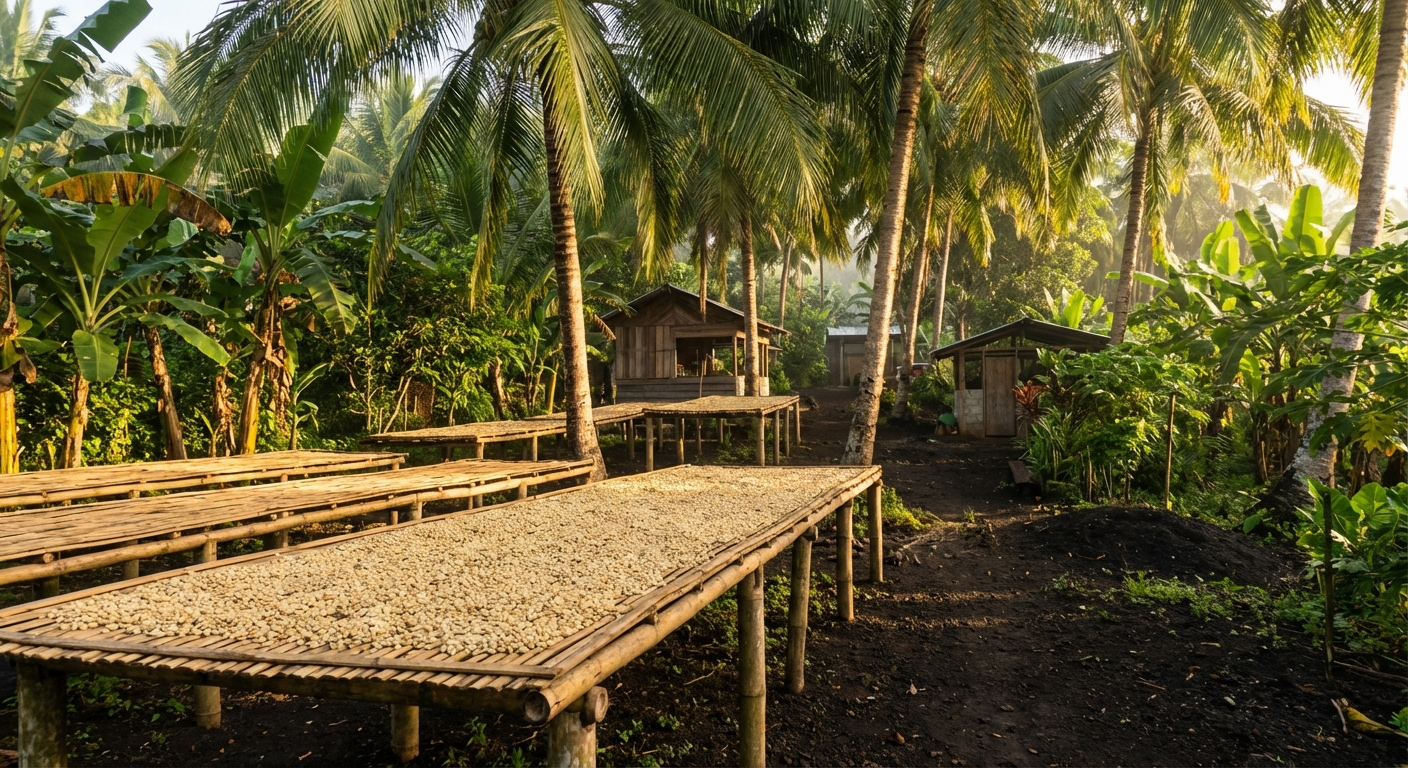
Understanding the processing methods used on Siquijor helps explain the distinct flavor profile of the island’s coffee. The vast majority of beans are processed using the natural or dry method, which involves spreading freshly harvested cherries on bamboo mats or concrete patios to dry in the sun for one to three weeks.
This approach is practical for small-scale farmers who lack the equipment for washed processing, and it also imparts the heavy-bodied, fruity sweetness that characterizes much of Philippine Robusta. The dried cherries are then hulled by hand or with simple mechanical hullers to extract the green beans.
A smaller number of producers have adopted a semi-washed or honey process, where the outer skin is removed but some of the mucilage is left on the bean during drying. This produces a cleaner cup while retaining some of the sweetness of natural processing.
Roasting on Siquijor ranges from traditional to modern. Some farmers still roast in a kawali (wok) over charcoal, stirring constantly to achieve an even roast. The result is an intensely aromatic, slightly smoky coffee that tastes unmistakably local. Meanwhile, the island’s newer cafes source from local roasters who use drum roasters and pay closer attention to roast profiles, producing beans suitable for espresso machines and pour-over brewing.
The Island’s Cafe Scene
Five years ago, finding a good cup of brewed coffee on Siquijor meant knowing a local who roasted their own. Today, a small but growing number of cafes cater to both residents and visitors who want something beyond instant coffee sachets.
San Juan
The tourist hub of San Juan has the highest concentration of cafes. Several establishments along the main road serve espresso drinks, cold brew, and pour-over options, often using beans sourced from farms within the island or from specialty roasters in Dumaguete. The atmosphere in these cafes tends toward the relaxed and social, with open-air seating, reliable WiFi, and views of the ocean or surrounding greenery.
Siquijor Town
The capital town has fewer dedicated cafes, but the ones that exist tend to have a more local character. You are more likely to find traditional brewed coffee here, served strong and sweetened, alongside pan de sal or local rice cakes for breakfast. The public market area is a good place to buy freshly roasted beans in small bags, often unlabeled but consistently fresh.
Lazi
Lazi’s cafe options are limited but worth seeking out. A couple of small shops near the church and heritage area serve locally grown coffee, and the experience of drinking a cup of Siquijor-grown Robusta while looking at one of the oldest convents in Asia is hard to match for atmosphere.
Visiting a Coffee Farm
Siquijor does not yet have the organized agri-tourism infrastructure of regions like Sagada or Benguet, but informal farm visits are possible and rewarding. The best approach is to ask at your accommodation or hire a local guide who knows the highland barangays. Many farmers are happy to show visitors their coffee plants and explain their process, especially outside of harvest season when they have more time.
Harvest season for Robusta on Siquijor typically runs from November through February, which coincides with the peak dry season and the busiest tourist months. If you visit during this period, you may be able to observe or even participate in cherry picking. The work is labor-intensive, with each cherry hand-selected at peak ripeness, and experiencing it firsthand gives you a profound appreciation for the effort behind every cup.
When visiting farms, a few points of etiquette are worth remembering. Bring a small pasalubong, or gift, such as bread or snacks from town. Ask before photographing people or their property. If you buy beans directly from a farmer, pay the asking price without haggling, as margins for small-scale growers are already thin.
What Siquijor Coffee Tastes Like
Siquijor Robusta, when well-processed and properly roasted, defies the negative stereotypes that sometimes follow the Robusta variety. Expect a full body with low acidity, notes of dark chocolate and roasted nuts, and a lingering sweetness that reflects the natural processing method. The best lots have a clean finish without the harsh bitterness sometimes associated with Robusta.
Beans that have been honey-processed show more fruit character, with hints of ripe mango or dried papaya layered beneath the chocolate and nut notes. These tend to be produced in smaller quantities and are more commonly found in the island’s specialty cafes than in the market.
The overall flavor profile is approachable and satisfying rather than complex or delicate. It pairs well with the heavy sweetness of local kakanin (rice cakes) and the savory richness of a Siquijor breakfast of dried fish and garlic rice.
Buying Coffee to Take Home
If you want to bring Siquijor coffee home as a souvenir, you have several options. The public markets in Siquijor Town and Larena sometimes carry locally roasted beans in simple plastic bags, typically priced between 100 and 200 pesos per 250 grams. These are usually roasted dark in the traditional style.
Several cafes in San Juan sell packaged beans from their own suppliers, often with more attention to roast date and variety information. These tend to cost slightly more, around 250 to 400 pesos per 250 grams, but offer a more consistent product.
For the freshest possible beans, buy directly from a farmer or local roaster in the highlands. You may need to ask your accommodation host or a tricycle driver to help arrange this, but the resulting coffee, roasted within days of your purchase, will be incomparably fresh.
The Future of Siquijor Coffee
The island’s coffee sector is at an inflection point. Production remains small, but awareness is growing among both farmers and consumers. Several factors suggest that Siquijor coffee could become a more significant part of the island’s economy and identity in the coming years.
The arrival of commercial flights to Siquijor in late 2025 has increased tourist numbers and, with them, demand for quality food and drink experiences. Visitors who have encountered specialty coffee elsewhere in the Philippines now expect it on Siquijor, creating market pull for better processing and roasting.
At the same time, younger Siquijodnon who have studied or worked in Cebu, Dumaguete, or Manila are returning with knowledge of the specialty coffee industry and interest in applying it to their family farms. This combination of external demand and local entrepreneurship is a pattern that has driven coffee revolutions in other Philippine regions.
Government support continues through seedling distribution and training programs, though advocates note that more investment in post-harvest facilities, particularly drying beds and mechanical dryers, would significantly improve bean quality and consistency.
Perhaps most importantly, coffee fits naturally into Siquijor’s broader narrative as a destination that values authenticity, sustainability, and connection to the land. An island known for its healers, its balete tree, and its unhurried pace of life is a fitting home for coffee that is grown slowly, processed carefully, and enjoyed without rush.
Practical Tips for Coffee Lovers Visiting Siquijor
Plan your cafe visits for the morning or mid-afternoon, when beans are freshest and baristas are least rushed. Many cafes close by early evening.
If you are particular about brewing method, ask what is available. Espresso-based drinks are standard at most tourist-oriented cafes, but pour-over and French press options are becoming more common.
Bring a small airtight container if you plan to buy whole beans. The humid tropical climate can degrade roasted coffee quickly, and a sealed container will help preserve freshness during the rest of your trip.
Do not overlook the simple brewed coffee served at local carinderias and market stalls. While it may lack the precision of specialty preparation, it represents the most authentic expression of Siquijor’s coffee tradition and costs just 15 to 30 pesos per cup.
Finally, remember that the island’s coffee industry is young and evolving. Quality varies between farms, roasters, and seasons. Approach each cup with curiosity rather than rigid expectations, and you will find that Siquijor coffee, like the island itself, rewards those who take time to appreciate what makes it different.
Siquijor.xyz Editorial Team
Related Experiences

Siquijor Artisan Workshops: Weaving, Woodcarving & Local Crafts
Discover Siquijor's traditional crafts through hands-on workshops. Learn from local artisans who preserve ancestral techniques in weaving, carving, and more.
Fishing with Siquijor's Fishermen: A Pre-Dawn Ocean Adventure
Join local fishermen for an authentic pre-dawn fishing experience. Learn traditional techniques, witness sunrise at sea, and connect with Siquijor's maritime culture.
Siquijor Food Guide: Local Dishes & Where to Eat
Discover Siquijor's authentic cuisine from street food to seafood feasts. Local restaurants, traditional dishes, and the flavors that define the island.