Essential Bisaya Phrases for Siquijor: Speak Like a Local
Learn 25 essential Bisaya (Cebuano) phrases that will help you connect with locals, navigate markets, and enrich your Siquijor Island experience.
There is a moment that every traveler to Siquijor encounters at least once. You are standing at a roadside sari-sari store, pointing at a bag of dried fish or a cold bottle of Coke, and the vendor says something rapid and melodic that you cannot quite catch. You smile, they smile, the transaction happens through gestures and goodwill. But something is missing.
That something is language. Not fluency, not perfection, but the simple willingness to try a few words in the tongue that has shaped this island for centuries. In Siquijor, that language is Bisaya, the local name for Cebuano, a Visayan language spoken by roughly 27 million people across the central and southern Philippines.
You do not need to speak Bisaya to enjoy Siquijor. English is understood in most tourist-facing establishments, and Filipinos are famously accommodating with foreign visitors. But learning even a handful of phrases will change the texture of your trip. Doors open differently when you greet someone in their own language. Prices sometimes shift. Stories emerge. The island reveals a layer that remains invisible to those who only speak in English.
This guide covers 25 essential Bisaya phrases organized by situation, with pronunciation tips and cultural context that will help you move through Siquijor with greater confidence and connection.
Why Bisaya Matters in Siquijor
Siquijor sits in the Visayan region of the Philippines, surrounded by Cebuano-speaking neighbors like Cebu, Bohol, and Negros Oriental. While the national language is Filipino (based on Tagalog), Bisaya is the mother tongue here. It is the language of the market, the fishing boat, the family dinner table, and the barangay hall.
When a tourist attempts even broken Bisaya, the reaction is almost always the same: surprise, followed by delight, followed by a conversation that goes much deeper than the typical tourist exchange. Siquijodnons, as the island’s residents are sometimes called, take genuine pride in their language and respond warmly to anyone who makes the effort.
There is also a practical dimension. Outside the main tourist corridor of San Juan, English proficiency drops. In the interior barangays, at mountain viewpoints, and along the quieter stretches of coast in Maria or Enrique Villanueva, a few Bisaya phrases can be the difference between confusion and clarity.
Greetings and Basic Courtesies
The foundation of any language starts with how you say hello and thank you. These phrases alone will carry you through most casual interactions.
Maayong buntag (mah-AH-yong boon-TAG) means “good morning” and is the standard greeting before noon. Swap “buntag” for hapon (hah-PON) in the afternoon and gabii (gah-BEE-ee) in the evening. These are the most natural way to begin any interaction, whether you are entering a restaurant, approaching a tricycle driver, or greeting your guesthouse host.
Kumusta ka? (koo-MOOS-tah kah) is “how are you?” and works in both formal and informal settings. The typical response is Maayo man (mah-AH-yo mahn), meaning “I’m fine” or “doing well.”
Salamat (sah-LAH-maht) is “thank you” and may be the single most useful word you learn. Add kaayo (kah-AH-yo) after it for emphasis: “Salamat kaayo” means “thank you very much.” You will use this dozens of times per day.
Palihog (pah-lee-HOG) means “please” and softens any request. Combining it with a smile makes almost any ask smoother.
Pasayloa ko (pah-sigh-LO-ah ko) means “excuse me” or “forgive me” and is useful when navigating crowded spaces, accidentally bumping someone, or needing to get past in a narrow alley.
At the Market and Shops
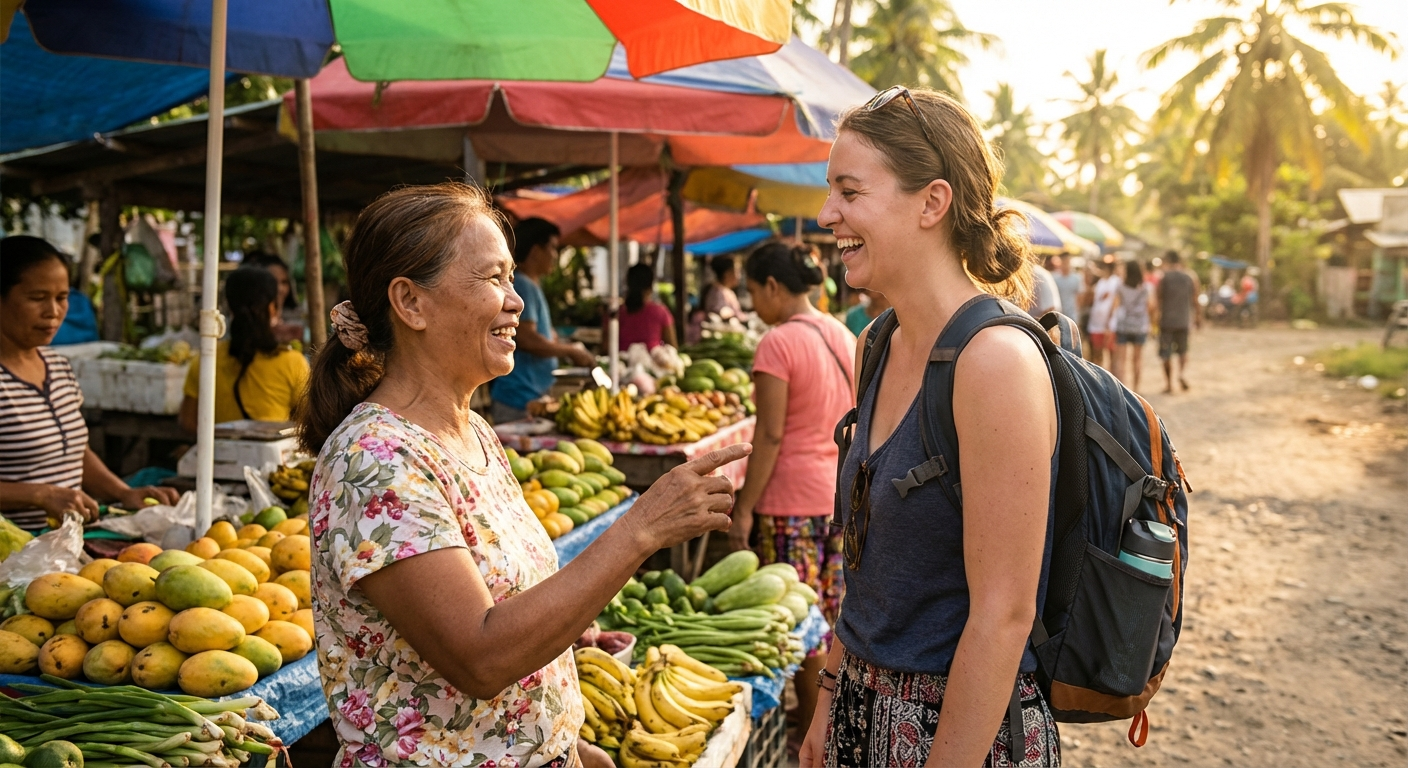
Siquijor’s public markets in Siquijor town and Lazi are where language skills become immediately practical. Vendors appreciate the effort, and the experience becomes richer when you can ask basic questions.
Tagpila ni? (tahg-pee-LAH nee) means “how much is this?” and is probably the second most important phrase after “salamat.” Point at the item, ask the question, and you will get a number in response. If the number is too fast to catch, hold up your phone calculator and let them type it.
Mahal kaayo (mah-HAHL kah-AH-yo) means “too expensive” and is said with a gentle smile, never aggressively. Bargaining is common at markets but should always remain friendly. A slight shake of the head paired with this phrase often results in a lower offer.
Barato na (bah-RAH-to nah) means “make it cheaper” or “that’s cheap” depending on context. Use it as a gentle nudge during price discussions.
Unsay ngalan ani? (oon-SIGH ngah-LAHN ah-NEE) translates to “what is this called?” and is invaluable when you encounter unfamiliar fruits, dried goods, or local snacks. Siquijor markets are full of items that do not appear in tourist guidebooks, and asking this question often leads to an impromptu cooking lesson.
Usa ra (oo-SAH rah) means “just one” and is useful when buying individual pieces of fruit, bread, or street food. For two, say duha (doo-HAH); for three, tulo (too-LO).
Getting Around
Transportation on Siquijor is informal. Tricycles, motorcycles, and the occasional multicab are the primary ways to move, and drivers appreciate passengers who can communicate basic destinations and needs.
Asa ang…? (ah-SAH ahng) means “where is…?” and works by adding the destination after the phrase. “Asa ang Cambugahay Falls?” will get you pointed in the right direction even if the full conversation switches to a mix of Bisaya and English.
Palihug, dad-a ko sa… (pah-lee-HOOG, dahd-AH ko sah) means “please, take me to…” and is the standard way to request a tricycle ride to a specific destination. State the place name clearly after the phrase.
Unsa kadugay? (oon-SAH kah-doo-GUY) means “how long will it take?” and helps set expectations for travel time around the island. The answer will usually come as a number of minutes.
Layo ba? (lah-YO bah) means “is it far?” and is a simpler alternative when you just need a general sense of distance. The answer is either Layo (far), Duol ra (doo-OHL rah, meaning “it’s close”), or a hand gesture indicating something in between.
Para lang (PAH-rah lahng) means “stop here” and is essential when riding in a tricycle or multicab. Say it clearly when you are approaching your destination, and the driver will pull over.
Eating and Drinking
Food is central to Filipino culture, and expressing your enjoyment in Bisaya elevates any dining experience from transactional to personal.
Lami kaayo (lah-MEE kah-AH-yo) means “very delicious” and is the phrase that will earn you the biggest smile from any cook, vendor, or restaurant owner. Say it with genuine enthusiasm after tasting a dish, and watch the response. This phrase alone has been known to produce second helpings at no charge.
Busog na ko (boo-SOG nah ko) means “I’m full” and is a polite way to decline additional servings. Filipino hospitality often involves persistent offers of more food, and this phrase signals that you are satisfied without offending the host.
Puwede mo-order ko og…? (poo-WEH-deh mo-OR-der ko og) means “can I order…?” and works in casual eateries and carinderias where there may not be a written menu. Pair it with pointing at what someone else is eating or naming a dish you recognize.
Tubig palihog (too-BIG pah-lee-HOG) means “water please” and is straightforward and essential, especially during the hot March days when hydration is critical.
Connecting with People
The phrases that matter most are often the ones that have nothing to do with transactions. These are the words that turn a stranger into an acquaintance and sometimes into a friend.
Gikan ko sa… (gee-KAHN ko sah) means “I’m from…” and answers the question you will be asked most frequently in Siquijor. Locals are genuinely curious about where visitors come from. Fill in your country or city after the phrase.
Nindot kaayo ang Siquijor (neen-DOT kah-AH-yo ahng see-KEE-hor) means “Siquijor is very beautiful” and is both a compliment and a conversation starter. Islanders take deep pride in their home, and hearing a visitor express this sentiment in Bisaya creates an immediate bond.
Pwede mo-picture? (PWEH-deh mo-PIK-tyur) means “can I take a photo?” and shows respect before pointing a camera at someone. While many Filipinos are happy to be photographed, asking first, especially in Bisaya, demonstrates cultural sensitivity.
Amigo or amiga (ah-MEE-go / ah-MEE-gah) means “friend” and is borrowed from Spanish but used frequently in casual Bisaya conversation. Addressing someone as “amigo” after a positive interaction reinforces goodwill.
Mubalik ko (moo-BAH-lik ko) means “I’ll come back” and is a lovely way to end an interaction at a shop, restaurant, or guesthouse. Whether or not you actually return, the sentiment is appreciated and remembered.
Pronunciation Tips
Bisaya pronunciation is more consistent than English. Vowels are always pronounced the same way: A as in “father,” E as in “bed,” I as in “see,” O as in “go,” and U as in “true.” There are no silent letters. Every letter in a word is spoken.
Stress patterns vary, but when in doubt, emphasize the second-to-last syllable. This works correctly for the majority of common words and phrases.
The “ng” sound, as in “nindot” or “ngalan,” may feel unfamiliar to English speakers. It is the same sound as the “ng” in “singing” but can appear at the beginning of a word. Practice by saying “singing” and then dropping the “si” to isolate the nasal sound.
Do not worry about tonal precision. Bisaya is not a tonal language, so mispronouncing a vowel length or stress will not change the meaning of a word the way it would in Mandarin or Thai. Locals will understand you from context, and they will correct you gently if needed.
Common Mistakes to Avoid
The most common error is mixing Tagalog with Bisaya. While both are Filipino languages, they are mutually unintelligible in many cases. Saying “salamat po” (Tagalog for “thank you, respectfully”) instead of “salamat” will not cause offense, but it signals that you are using a phrasebook from the wrong region. Siquijodnons are Bisaya speakers first.
Another mistake is speaking too loudly or too slowly when using Bisaya phrases. Locals do not need exaggerated delivery. Speak at a normal conversational volume, and let the words do the work.
Avoid using Bisaya in a way that feels performative. The goal is not to impress people with how many phrases you memorized. The goal is to communicate respect and genuine interest. Even one or two phrases used naturally at the right moment will have more impact than reciting an entire vocabulary list.
Building Your Vocabulary Over Time
Start with three phrases on your first day: “Maayong buntag” (good morning), “Salamat” (thank you), and “Lami kaayo” (delicious). Use them consistently with every interaction. By day two, add “Tagpila ni?” (how much?) and “Asa ang…?” (where is?). By day three, you will find yourself picking up additional words naturally from context.
Keep a small notebook or a note on your phone where you write down new words as you hear them. Ask your guesthouse host or tricycle driver to teach you one new word each day. This approach is more effective than memorizing a long list before your trip, because the words are tied to real experiences and real faces.
Many travelers who spend a week or more in Siquijor leave with a working vocabulary of 40 to 50 words, enough to navigate basic situations without English and enough to earn the quiet respect of islanders who have watched thousands of tourists pass through without ever learning to say “good morning” in Bisaya.
A Final Word
Language is the most intimate form of travel. When you say “Maayong buntag” to the fisherman mending his nets at dawn, or “Lami kaayo” to the grandmother who cooked your lunch, you are doing more than practicing vocabulary. You are acknowledging that this place has its own voice, its own rhythm, its own way of naming the world.
Siquijor is often described as mystical, enchanted, otherworldly. But it is also deeply real, inhabited by people who live ordinary lives in a language that most visitors never bother to learn. The phrases in this guide are a small bridge across that gap. Use them freely, imperfectly, and with the understanding that in Siquijor, the effort matters far more than the execution.
Salamat kaayo for reading. Now go practice.
Frequently Asked Questions
What language do they speak in Siquijor?
Do I need to learn Bisaya to visit Siquijor?
Is Bisaya the same as Cebuano?
Siquijor.xyz Editorial Team
Related Experiences

Siquijor Artisan Workshops: Weaving, Woodcarving & Local Crafts
Discover Siquijor's traditional crafts through hands-on workshops. Learn from local artisans who preserve ancestral techniques in weaving, carving, and more.
Fishing with Siquijor's Fishermen: A Pre-Dawn Ocean Adventure
Join local fishermen for an authentic pre-dawn fishing experience. Learn traditional techniques, witness sunrise at sea, and connect with Siquijor's maritime culture.
Siquijor Food Guide: Local Dishes & Where to Eat
Discover Siquijor's authentic cuisine from street food to seafood feasts. Local restaurants, traditional dishes, and the flavors that define the island.