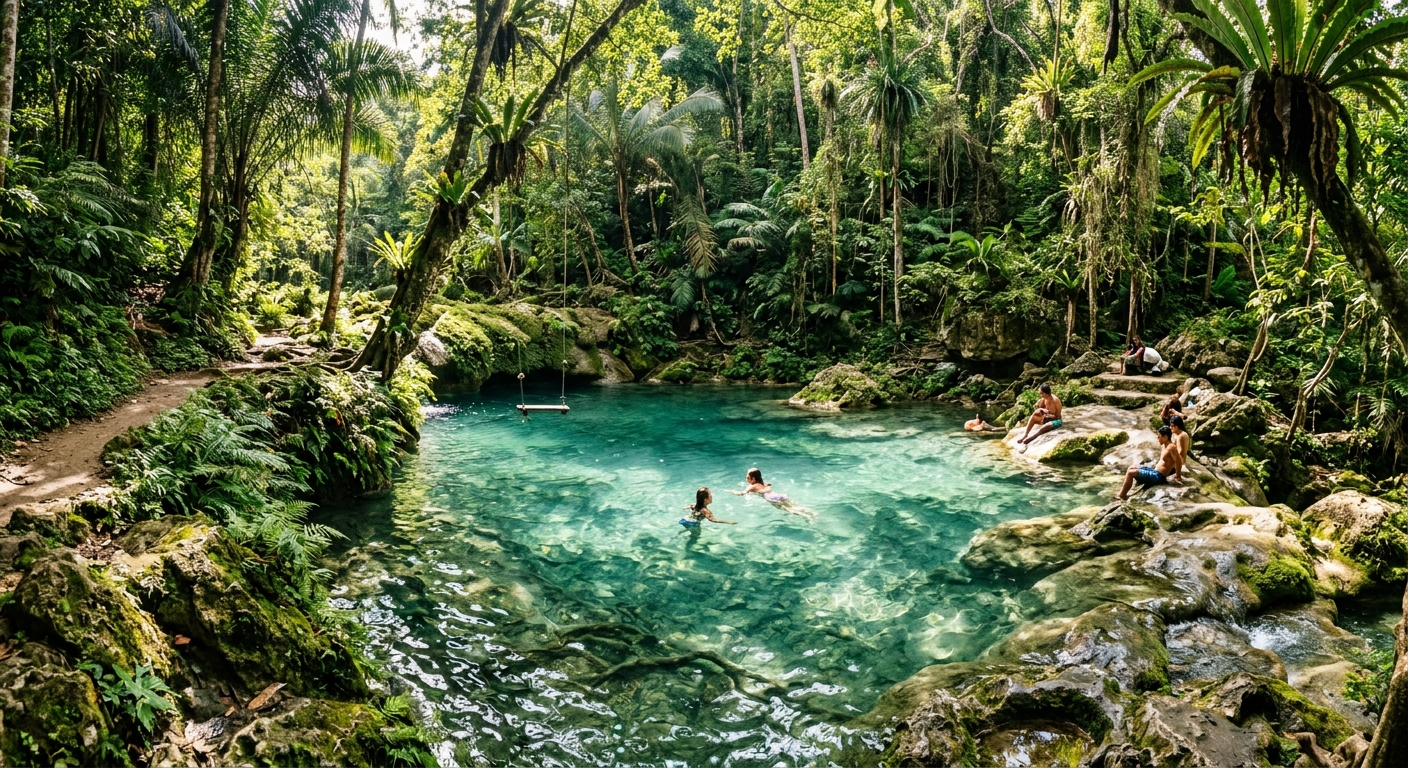
Siquijor's Freshwater Springs and Natural Pools: A Hidden Island Adventure
Discover Siquijor's freshwater springs, natural swimming pools, and sacred water sources beyond the famous waterfalls and beaches.
Most visitors to Siquijor follow a well-worn path: waterfalls, beaches, the Balete tree, maybe a cave. Nothing wrong with that route. Those attractions earned their reputation. But there is an entire network of freshwater springs scattered across the island that barely registers on most travel itineraries, and these springs represent some of the purest, most peaceful swimming experiences in the entire Visayas.
Siquijor is a raised coral island with a limestone foundation that acts as a massive natural filter. Rainwater percolates through layers of rock over months or years before emerging as springs that are startlingly clear, consistently cool, and often surrounded by dense tropical vegetation that makes each one feel like a private discovery. Some of these springs feed the island’s famous waterfalls. Others pool quietly in the forest interior, known only to nearby farming communities.
This guide covers the springs and natural pools worth seeking out, how to find them, and what to expect when you arrive.
Why Siquijor’s Springs Are Special
The geology of Siquijor explains everything. The island is essentially a block of ancient coral limestone pushed above sea level by tectonic forces. This porous rock absorbs rainfall like a sponge, filtering it through millions of tiny channels before it re-emerges at lower elevations as springs.
The result is water that is naturally purified, mineral-rich, and remarkably clear. Visibility in many springs exceeds five meters, and the water temperature hovers between 24 and 26 degrees Celsius year-round, making it refreshingly cool without being cold. The limestone also gives the water a slightly alkaline quality that feels noticeably soft on the skin compared to the chlorinated pools most travelers are used to.
This same geological process is what makes Siquijor’s waterfalls so impressive. Cambugahay Falls, Lugnason Falls, and Lagaan Falls are all spring-fed, which is why they flow even during dry season when rainfall is minimal. But the springs themselves, before they cascade over rock faces, often form pools that are quieter, less visited, and equally beautiful.
The Springs Worth Finding
Capilay Spring Park, San Juan
Capilay is the most accessible spring on the island and the only one developed into a proper park. Located in the center of San Juan town, it is a large natural pool fed by an underground spring that produces thousands of liters of fresh water per minute. The pool is roughly the size of a standard swimming pool but entirely natural, surrounded by old trees and a simple park setting.
What makes Capilay notable is its role in local life. This is where San Juan residents come to cool off, where children learn to swim, and where families gather on weekend afternoons. It is not a tourist attraction in the conventional sense, which is precisely why it is worth visiting. Arriving on a weekday morning, you may have the pool largely to yourself. The water is chest-deep in most areas, clear enough to see the sandy bottom, and cool enough to make the midday heat disappear.
There is no entrance fee, though donations to the park’s maintenance are appreciated. Basic facilities include changing rooms and a few benches. A small sari-sari store across the road sells drinks and snacks.
How to find it: In the center of San Juan town, about 200 meters from the main road. Any tricycle driver knows it. Look for the large trees near the municipal hall.
Lazi Springs, Lazi
The municipality of Lazi sits on some of the island’s most active spring systems. Several springs emerge along the river that runs through the town, and the areas upstream from the main road bridge offer natural pools that are rarely visited by tourists.
The most accessible is a series of shallow pools about a 15-minute walk upstream from the Lazi church. The water here is knee to waist deep, flowing over smooth limestone rocks that have been polished by centuries of water movement. The surrounding forest canopy keeps the area shaded for most of the day, and the only sounds are running water and birds.
A second, deeper pool exists further upstream but requires a guide to find. This pool sits at the base of a small rock face where the spring emerges directly from the hillside. The water is noticeably cooler here, suggesting a deeper underground source, and the pool is deep enough for swimming.
How to find it: Start at Lazi Church and walk toward the river. Ask at the barangay hall for a guide to the upstream springs. Guide fee is typically 200 to 300 PHP.
Tubod Spring, San Juan
Tubod means “spring” in Cebuano, and the area of San Juan known as Tubod is named for the freshwater springs that emerge near the coast. The most famous feature here is Tubod Marine Sanctuary, where freshwater springs actually emerge underwater along the shoreline, creating visible plumes of cooler, clearer water that mix with the sea.
But the springs themselves, before they reach the ocean, form a small creek with several pools that are perfect for a quick freshwater rinse after snorkeling. The largest pool is about three meters across and waist deep, shaded by coastal trees, and connected to the beach by a short path.
This is one of the few places in the Visayas where you can snorkel a coral reef and then walk 50 meters inland to soak in a freshwater spring. The combination is genuinely unique and makes the Tubod area one of the most underrated spots on the island.
How to find it: From Tubod Marine Sanctuary, walk inland along the small creek. The main pool is about 100 meters from the beach.
Cang-atong Spring, Maria
The municipality of Maria, on the western side of the island, is the least visited by tourists and home to some of the most pristine springs. Cang-atong Spring sits in the forested interior above the coastal town, reached by a 30-minute walk along a farm trail that climbs gradually through coconut groves and then into secondary forest.
The spring emerges from a limestone outcrop into a natural basin roughly four meters across and two meters deep. The water is among the clearest on the island. On a sunny day when light penetrates through the canopy, the pool takes on an electric blue-green color that looks enhanced in photographs but is completely natural.
This is not a developed site. There are no facilities, no signs, and no entrance fee. The trail can be muddy after rain, and you will need a guide from the nearest community to find it. But the reward for the effort is a swimming experience that feels genuinely wild, completely private, and connected to the island in a way that more popular attractions cannot match.
How to find it: In Barangay Cang-atong, Maria. Ask at the barangay hall for a guide. The walk takes about 30 minutes each way. Wear sturdy footwear.
Bandilaan Forest Springs, Interior
Mount Bandilaan, the highest point on the island, is the source of multiple spring systems that flow outward in all directions. The forested slopes of the mountain, now protected as a national park, contain dozens of small springs and seeps that collect in natural depressions and rocky channels.
The most accessible of these forest springs is along the trail system near the Butterfly Sanctuary. About 20 minutes into the forest on the trail toward the summit, a side path leads to a series of shallow pools where spring water collects in natural limestone basins. The pools are small, some only large enough for two or three people, but the setting in dense forest with filtered light and complete silence is extraordinary.
These are not swimming pools in the conventional sense. They are more like natural soaking pools, ideal for sitting in cool water after a hike. The water rarely exceeds waist depth, but the experience of immersing yourself in crystal-clear spring water in the middle of a protected forest is one of the most memorable things you can do on Siquijor.
How to find it: Start at the Butterfly Sanctuary near the Bandilaan summit road. The springs are along the forest trail system. A guide from the sanctuary can point you in the right direction.
Salagdoong Springs, Enrique Villanueva
Most visitors to Salagdoong know the beach and the cliff jumping platforms. Fewer know about the freshwater springs that emerge in the forested area above the beach. These springs feed a small creek that runs down through the resort grounds before reaching the sea.
Walking upstream from the main beach area for about 10 minutes along the creek bed leads to a series of natural pools where the water is entirely fresh. The largest is about five meters across and deep enough to submerge completely. The creek bed is rocky, so water shoes are essential, but the pools themselves have sandy bottoms.
The springs are technically within the Salagdoong Resort complex, so the standard entrance fee of 40 PHP gives you access. The advantage of visiting these springs is that you can combine them with a beach and cliff jumping visit, making for a full day of water activities in one location.
How to find it: Enter Salagdoong Resort and follow the creek upstream from the main beach. The pools are about a 10-minute walk.
How to Plan a Springs Tour
Best Time to Visit
The springs flow year-round, which is one of their advantages over rain-dependent waterfalls. However, the dry season from December through May offers the best conditions. Water clarity is highest, trails are drier and easier to navigate, and the contrast between the cool spring water and the warm air is most refreshing.
During the rainy season from June through October, the springs still flow but water clarity can drop after heavy rains as runoff introduces sediment. Trails to more remote springs may become slippery or impassable during sustained rain.
What to Wear and Bring
Water shoes or sport sandals with good grip are essential. Many springs are reached by trails that cross rocky stream beds, and the limestone around springs can be sharp and slippery. Regular flip-flops are not adequate.
A dry bag protects your phone and other electronics. Even if you do not plan to swim, the humidity near springs is high and splashing is inevitable. Reef-safe, biodegradable sunscreen is important even in shaded springs because filtered sunlight can still cause burns during extended soaking.
Bring your own drinking water. None of the undeveloped springs have vendors nearby, and the hikes to reach them can be sweaty. One liter per person minimum for a half-day trip.
Hiring Guides
For any spring beyond Capilay and Salagdoong, a local guide is strongly recommended. The practical reasons are obvious. Many springs are on unmarked trails that branch through farmland and forest, and without local knowledge you can spend hours looking for something that is a 20-minute walk with guidance.
But there is a more important reason. These springs are part of local communities. The water is used for drinking, washing, and irrigation. Arriving with a guide from the community signals respect and ensures that visitors use the springs responsibly. It also puts money directly into the local economy in a way that benefits the people who actually steward these water sources.
Guide fees range from 200 to 500 PHP depending on the distance and difficulty. This is genuinely good value for the experience you get and the local knowledge that comes with it.
Combining with Other Activities
A springs tour combines naturally with other interior activities. You can visit a spring in the morning, hike Mount Bandilaan in the late morning, and stop at a waterfall in the afternoon. Or you can combine a coastal spring visit at Tubod with snorkeling in the marine sanctuary.
The key is to schedule spring visits for early morning or late afternoon when the light in the forest is best and the temperature difference between air and water is most noticeable. Midday visits work too, especially when the heat drives you to seek the coolest water available.
The Cultural Significance of Springs
Springs hold a deeper meaning on Siquijor than simple recreation. In the island’s healing traditions, certain springs are considered sacred, their water believed to carry cleansing and restorative properties. The practice of using spring water in healing rituals dates back centuries, predating Spanish colonial influence and continuing today alongside modern medicine.
Some springs are associated with specific healers or families who have traditionally used their water in preparations of herbal medicines. Visiting these springs requires particular sensitivity. They are not tourist attractions but living parts of a cultural and spiritual tradition. If a guide mentions that a particular spring is used for healing purposes, approach it with the same respect you would give any place of spiritual significance.
The connection between springs and healing also explains why Siquijor’s water has a reputation among Filipino visitors. Many people from other islands specifically seek out Siquijor spring water, believing it has qualities that water from other sources does not. Whether this belief has a scientific basis in the mineral content of the limestone-filtered water or is rooted entirely in cultural tradition, it adds a layer of meaning to the experience of swimming in these springs that goes beyond simple refreshment.
Protecting the Springs
Siquijor’s freshwater springs are not an infinite resource. The island’s water table depends on rainfall percolation through intact forest cover, which means deforestation and development directly threaten the springs that make the island unique.
Several of the springs described in this guide have already shown reduced flow in recent years as development increases on the island. Capilay Spring Park, once described as having enough flow to power a small mill, now flows at a fraction of its historical volume during dry season.
Visitors can help protect these springs by following simple practices. Do not use soap, shampoo, or non-biodegradable sunscreen in or near spring water. Stay on established trails to avoid erosion. Carry out all trash including biodegradable items like fruit peels. And support the communities that steward these springs by hiring local guides and contributing to environmental fees where they exist.
The springs of Siquijor are among the island’s most precious and most overlooked features. Finding them requires more effort than visiting a beach or a developed waterfall, but the reward is an experience of the island that most visitors never discover. These pools of clear, cool water hidden in the forest interior represent Siquijor at its most authentic, a place where nature, culture, and geology come together in something genuinely worth seeking out.
Frequently Asked Questions
Are Siquijor's freshwater springs safe to swim in?
Do I need a guide to visit the springs?
What should I bring when visiting freshwater springs?
Is there an entrance fee for the springs?
Siquijor.xyz Editorial Team
Local experts sharing authentic Siquijor experiences
Related Experiences
Apo Island Day Trip: Swimming with Sea Turtles
Complete guide to visiting Apo Island from Siquijor - swim with sea turtles, explore vibrant coral reefs, and experience one of the Philippines' best marine sanctuaries.

Cantabon Cave Spelunking: An Underground Adventure in Siquijor
Navigate underground rivers, squeeze through tight passages, and discover stunning rock formations in Siquijor's most thrilling cave system. Complete spelunking guide included.
Cliff Jumping at Salagdoong Beach
Your complete guide to cliff jumping at Salagdoong Beach - Siquijor's most thrilling adventure with platforms at 5m, 8m, and 10m heights.