Siquijor Eco-Lodges: Where to Sleep Green on the Island
Discover eco-friendly accommodation in Siquijor from bamboo cottages to solar-powered resorts. Your guide to sustainable stays on the island.
Siquijor has always felt like an island that resists being rushed. Its old-growth balete trees, coral-rich coastlines, and quiet mountain villages carry a sense of permanence that most Philippine destinations lost decades ago. That quality is precisely why sustainable accommodation Siquijor visitors are seeking has become more than a trend here. It is a natural extension of the island’s character.
As tourism grows steadily across the Visayas, Siquijor faces a familiar crossroads. The island can follow the path of overdevelopment that reshaped Boracay and parts of Palawan, or it can chart a different course. A growing number of property owners, foreign and Filipino alike, are choosing the latter. The result is a collection of Siquijor eco-lodges, bamboo cottages, farm stays, and solar-powered guesthouses that prove comfortable travel and environmental responsibility are not mutually exclusive.
This guide covers where to find green stays Siquijor has to offer, what makes each type of sustainable accommodation unique, and how to choose the right one for your trip.
Why Eco-Lodges Matter for Siquijor
Siquijor is a small island. At roughly 340 square kilometers with a population under 100,000, it lacks the infrastructure buffers that larger destinations rely on. There is no centralized sewage treatment plant. Freshwater comes from limited springs and wells. Power still depends heavily on undersea cables from neighboring Negros, supplemented by scattered solar installations.
Every concrete resort with an infinity pool and air-conditioned rooms draws on these finite resources. Eco-friendly hotels Siquijor needs are not just a marketing angle. They are a practical response to the island’s carrying capacity. Properties that use rainwater harvesting, solar panels, natural ventilation, and locally sourced building materials reduce the strain on systems that were never designed for mass tourism.
There is also the cultural dimension. Siquijor’s identity is deeply tied to its natural landscape. The healers who practice traditional medicine gather herbs from forest floors. Fishermen depend on healthy reef systems. When accommodation choices protect these ecosystems rather than degrade them, they help preserve the very qualities that make the island worth visiting.
Types of Sustainable Stays on the Island
Bamboo Cottages
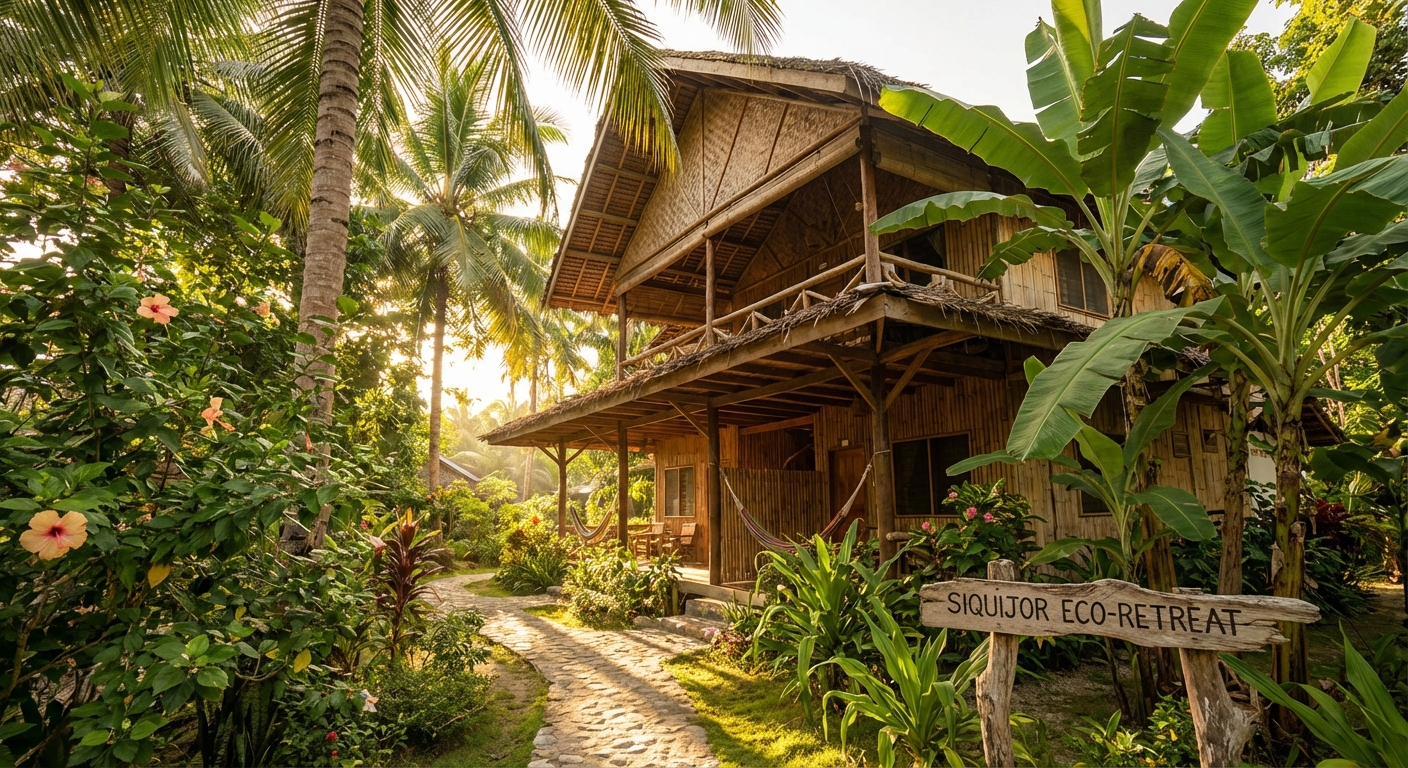
Bamboo construction is the most visible marker of eco-conscious accommodation in Siquijor. These cottages use locally harvested bamboo for framing, walls, and sometimes flooring, paired with nipa palm or cogon grass thatching for roofing. The material is renewable, grows abundantly across the island, and provides natural insulation against tropical heat.
Bamboo cottages Siquijor properties offer range from simple open-air huts with mosquito nets to well-appointed rooms with private bathrooms and comfortable bedding. Expect to pay between PHP 800 and PHP 2,500 per night depending on the level of finish and proximity to the coast. Properties along the San Juan beachfront tend to sit at the higher end, while inland options near Lazi and Maria offer better value.
The best bamboo stays feature cross-ventilation design that eliminates the need for air conditioning, composting toilets or efficient septic systems, and gardens that serve as both landscaping and food sources for on-site kitchens.
Treehouse and Elevated Stays
A handful of properties in Siquijor have taken the concept of elevated living literally. Treehouse-style accommodations built into or around mature trees offer a unique experience that also minimizes ground disturbance. By building upward rather than clearing land, these stays preserve root systems, maintain natural drainage patterns, and protect understory vegetation.
Treehouse stays are concentrated in the hillier interior areas, particularly around the municipalities of Maria and Lazi where the terrain rises toward Mount Bandilaan. Prices typically range from PHP 1,500 to PHP 4,000 per night. The trade-off is remoteness. You will need a motorbike or habal-habal to reach most of these properties, and some are a genuine twenty-minute ride from the nearest paved road.
What you gain is silence, forest views, and a sense of disconnection from the coastal tourist circuit that feels increasingly valuable.
Solar-Powered Resorts and Guesthouses
Solar energy adoption in Siquijor has accelerated in recent years, driven by both environmental motivation and practical necessity. Power outages remain a reality on the island, and properties that invest in solar panel arrays with battery storage can offer guests reliable electricity while reducing dependence on the grid.
Several mid-range resorts, particularly along the western coast between San Juan and Larena, now run partially or fully on solar power. These properties tend to be priced between PHP 2,000 and PHP 5,000 per night and often combine solar energy with other sustainable practices like water recycling, LED lighting, and plastic-free amenity kits.
When evaluating solar-powered claims, look for visible panel installations and ask about battery capacity. A property with a few small panels on the roof is making an effort but may still rely heavily on grid power for air conditioning and water heating. Fully off-grid stays Philippines travelers sometimes seek are rare on Siquijor but do exist in a few interior locations.
Farm Stays and Permaculture Properties
The newest addition to Siquijor’s sustainable accommodation scene is the farm stay. A small number of properties now combine guest accommodation with working organic farms or permaculture gardens. Guests wake up to the sound of roosters, eat breakfast made from ingredients grown on the property, and can participate in planting, harvesting, or composting activities.
Farm stays are most commonly found in the interior barangays of Lazi and Maria, where land is affordable and agricultural traditions remain strong. Prices range from PHP 600 to PHP 1,800 per night, often including meals. The experience suits travelers who want more than a beach holiday and are comfortable with basic amenities. Do not expect hotel-level polish, but do expect genuine hospitality and food that tastes remarkably different when it traveled five meters from garden to plate.
Where to Look: The Best Areas for Green Stays
San Juan
As Siquijor’s primary tourism hub, San Juan offers the widest selection of accommodation overall, including several properties with genuine eco credentials. The beachfront stretch between Paliton and Solangon has a mix of bamboo cottage operations and small resorts that incorporate sustainable building practices. San Juan is the most convenient base for first-time visitors, with easy access to restaurants, dive shops, and transport connections.
The trade-off is that San Juan’s popularity means higher prices and more development pressure. Properties here may blend eco practices with conventional resort features. Look for stays that demonstrate commitment beyond aesthetics, such as waste management programs, reef-safe sunscreen policies, and partnerships with local marine conservation groups like the Tubod Marine Sanctuary stewards.
Lazi
The municipality of Lazi, on Siquijor’s southern coast, is where sustainable travel Siquijor enthusiasts often find the most authentic eco-lodges. Development here is slower and less commercialized than San Juan, which means properties have more space, larger gardens, and closer integration with surrounding communities. The heritage town center, anchored by the San Isidro Labrador Church and the centuries-old convent, adds cultural depth to any stay.
Lazi’s interior barangays are particularly promising for farm stays and off-grid bamboo properties. The area around Cambugahay Falls draws day-trippers, but accommodation options remain limited, creating opportunities for small-scale eco operators who prefer a quieter clientele.
Maria
Maria is Siquijor’s least touristed municipality, occupying the island’s mountainous interior and northern coast. The terrain here is steeper, greener, and cooler, making it ideal for treehouse stays and hillside eco-cottages. Mount Bandilaan National Park falls partly within Maria’s boundaries, and several properties position themselves as gateways to the park’s hiking trails and butterfly sanctuaries.
Accommodation in Maria requires a willingness to trade convenience for immersion. There are fewer restaurants, no nightlife to speak of, and limited mobile signal in some areas. For travelers seeking a genuine off-grid experience in Siquijor, Maria delivers what other towns cannot.
What Actually Makes a Stay “Eco”
The term eco-lodge gets applied liberally across the Philippines, and Siquijor is no exception. A property with a bamboo facade and a recycling bin is not necessarily practicing responsible tourism Siquijor standards demand. When evaluating eco-friendly hotels Siquijor listings promote, look for concrete practices rather than vague claims.
Building Materials and Design
Genuine eco-lodges prioritize locally sourced, renewable, or reclaimed materials. Bamboo, coconut lumber, volcanic stone, and nipa palm are all traditional Siquijor building materials with low environmental footprints. Design should work with the climate rather than against it, using natural ventilation, elevated structures for airflow, and shade gardens to reduce cooling needs.
Energy and Water
Solar panels, rainwater collection systems, and gravity-fed water supplies are tangible indicators of environmental commitment. Ask about water heating methods, lighting sources, and whether the property uses a generator during outages or simply goes dark.
Waste Management
On a small island without sophisticated waste infrastructure, how a property handles garbage matters enormously. The best eco stays in Siquijor practice rigorous waste separation, composting of organic material, and elimination of single-use plastics. Some partner with local recycling cooperatives or operate their own upcycling workshops.
Community Integration
True sustainable accommodation supports the surrounding community. This means hiring local staff, sourcing food from nearby farmers and fishermen, and contributing to environmental or social programs. Properties that operate as isolated compounds, importing everything from Dumaguete, miss the point regardless of how many solar panels they install.
Tips for Choosing the Right Eco-Stay
Start by defining your comfort threshold. Sustainable stays in Siquijor span a wide range, from genuinely rustic bamboo huts with shared bathrooms to polished boutique properties that simply happen to run on solar power. Neither is more valid than the other, but knowing what you need for a good night’s sleep avoids disappointment.
Read recent reviews carefully, focusing on mentions of specific practices rather than general “eco” labels. A reviewer who mentions composting toilets, garden-to-table meals, or plastic-free bathrooms is telling you more than one who simply says the place felt “natural.”
Book directly when possible. Many small eco-lodges in Siquijor operate with razor-thin margins and lose a significant percentage to booking platform commissions. A direct booking via Facebook, WhatsApp, or the property’s own website often gets you a better rate while ensuring more of your money stays with the people doing the work.
Consider your transportation needs. Eco-lodges in Maria or interior Lazi may require a motorbike rental, which adds PHP 350 to PHP 500 per day to your budget. Factor this in when comparing prices with more accessible San Juan stays.
Booking During Peak Season: March Through May
The dry months from March to May represent Siquijor’s peak tourist season, and eco-lodges are not exempt from the demand surge. In fact, because sustainable properties tend to be smaller operations with fewer rooms, they often fill up faster than conventional resorts.
Book at least three to four weeks in advance for peak season stays, and six weeks or more for popular properties in San Juan. Lazi and Maria eco-lodges have slightly more availability due to lower overall demand, but the best ones still require advance planning.
Expect peak season pricing to run 20 to 40 percent higher than low season rates at most properties. Some eco-lodges maintain flat rates year-round as a matter of principle, which makes them particularly good value during March through May relative to conventional accommodation that spikes aggressively.
The shoulder months of February and June offer a compelling compromise. Weather remains largely favorable, prices drop, and you gain the advantage of a quieter island where your eco-lodge experience feels less like a curated tourism product and more like the real Siquijor.
Making Your Stay Count
Choosing sustainable accommodation in Siquijor is one of the most direct ways to influence the island’s future. Every booking at an eco-lodge sends a market signal that responsible development is commercially viable. Every night spent in a bamboo cottage rather than a concrete resort demonstrates that travelers value authenticity over uniformity.
Siquijor still has time to get this right. The island’s relative obscurity, limited port access, and small scale create natural brakes on overdevelopment that places like Siargao and El Nido no longer possess. By supporting the property owners who are building with the island rather than on top of it, visitors become participants in a model that the rest of Philippine tourism desperately needs.
Pack light, bring a reusable water bottle, and choose a place to sleep that earns the word green. The mystic island will reward you for it.
Island Adventures Team
Related Experiences
Day Trips from Siquijor: Dumaguete, Bohol & Beyond
Explore beyond Siquijor with day trips to Dumaguete city, Bohol's Chocolate Hills, and nearby attractions. Ferry schedules, costs, and practical planning tips.

Family Travel Guide to Siquijor: 2026 Complete Planning Resource
Plan the perfect Siquijor family vacation. Kid-friendly activities, family accommodations, safety tips, what to pack, and age-appropriate adventures.

How to Get to Siquijor in 2026: Complete Travel Guide
Everything you need to know about getting to Siquijor Island in 2026 - ferry routes, schedules, prices, and transportation options from Manila, Cebu, Bohol, and Dumaguete.